The Lone and Orange Sands

A correspondent asks, “Why don’t ‘jar of Tang’ stories work for readers?”

Before I take a stab at answering that one, some definition of terms is probably in order.  The concept of the “jar of Tang story” comes from the Turkey City Lexicon, a collection of workshop terms originally compiled by and for the Texas-based Turkey City Writers’ Workshop:

A story contrived so that the author can spring a silly surprise about its setting. . . . For instance, the story takes place in a desert of coarse orange sand surrounded by an impenetrable vitrine barrier; surprise! our heroes are microbes in a jar of Tang powdered orange drink.

This particular kind of failed story is especially common in science fiction and fantasy, since determining the nature of reality and figuring out the rules of the universe are recurring themes in both genres, and the reader is presumed to be an active participant in the process.

It’s also necessary to acknowledge that once in a while you’ll find a reader who actually likes this kind of story, because there’s no accounting for taste and nothing is so weird that there isn’t somebody out there who will like it.  Also, a sufficiently accomplished writer can make anything work — but for some stories, “sufficiently accomplished” means “maybe Will Shakespeare could have pulled it off on a good day.”  (But mostly Will Shakespeare didn’t even try, because part of being an accomplished writer is knowing how to pick your battles.)

Setting aside idiosyncratic tastes, here’s the big reason why “jar of Tang” stories don’t work:

Readers like being fooled; they don’t like being made to feel foolish.

Being fooled is the good kind of surprise, the one where the rabbit comes out of the hat and the ace of spades is on the top of the deck instead of in your hand and the nice young man who works at the coffee shop is really the Crown Prince of Ruritania in disguise.

Being made to feel foolish is something different.  It’s the writer saying to the reader, “Ha-ha, gotcha!  You totally thought that those characters you were identifying with had slogged across a vast and waterless desert only to come up hard against an impenetrable but transparent — and clearly the product either of magic or of superscience — wall!  But you were wrong!”

Whereupon the reader feels stupid for not having considered alternate interpretations, and feels like a chump for trusting the author to play straight with him or her, and is generally full of resentment and wounded ego — because the reader is supposed to be a fellow-traveller on the voyage of discovery that is the story, and not anybody’s dupe.

The Dreaded Middle

Beginnings are hard to write.

Endings are even harder to write.

But the hardest part of a book to write, hands down, is the middle.

The middle of the book is that part where ennui sets in, the part where you start to heartily dislike most of not all of your characters, or — if you still like them in spite of everything — the part where you become so tired of the fictional milieu you’ve embedded them in that you start to fantasize about lifting them out of it wholesale and giving them all jobs in a coffee shop instead.  The middle is where plots break down, where minor characters show up out of nowhere and attempt to hijack the narrative, where major characters suddenly take left turns into unmapped territory.

Sometimes the plot breakdown is obvious when you hit it, and you end up stalled for days or weeks or sometimes, heaven help you, years, until you work out what’s holding things up.  Other times, you don’t notice it until it’s time to do the revisions, and then you’re stuck doing a massive structural rewrite on a short deadline.

One way or another, with novels it’s the midgame that makes or breaks people.

One, Two, Three

The general rule, for position of things in a linear sequence:  The final position is the most emphatic, the initial position is the second-most emphatic, and the middle position is the least emphatic.

In terms of sentence structure, this is why you shouldn’t end a sentence with a weakening word like “though” or “however” (unless you have a specific reason for wanting that particular kind of anticlimactic effect), and why you should arrange your main and subordinate clauses in such a way as to reserve the final position for your most important idea.

In terms of plot structure, it goes a long way toward explaining why the middle of the book is always the hardest part to write.

Writers’ Tools

Writers need their good tools as much as any other crafts-person.  A few of my favorites:

That slow cooker I mentioned a couple of days ago.  It’s especially useful in hot weather, and on days when I’m so busy and/or so tired that I have only minimal brain space left for stuff like food and cooking.

A good word processor.  And by “good” I mean, “suited to your own preferences and writing habits.”  Also, a good word processor for generating text and a good word processor for formatting text are not necessarily the same program.

A good printer.  It’s not as necessary as it used to be for a working writer’s printer to be a heavy-duty workhorse capable of printing out 600-pages-and-up inside of 12 hours without breaking down or running out of ink — I think it’s been at least half a dozen books now, maybe more, since we turned in anything in hardcopy — but there are still times when you’ll need a printer, and when you do you’ll want one that doesn’t give up on you in mid-crisis.

A good computer, one with enough hard drive space to store your stuff and enough memory to do the things you need to do.

And all the little things — the red pencils, the index cards, the colored highlighters, the nice fountain pens, and so on — that ease a writer’s heart and make the process of composition easier.

What are your favorite or indispensable tools?

The Fanfic Thing

The Guardian (or one of its on-line columnists, at any rate), has discovered the existence of fanfic, and the predictable kerfuffle has ensued.  This moves me to repost here some of my thoughts from the last time this argument came around, which it does every three or four years whether we need it or not.

So:

If you’re a writer, and you don’t like fanfic, either with regard to your own works or in general:

Don’t waste breath and ink and internet connectivity telling fanfic writers that what they do is morally wrong, because they aren’t going to agree with you.

Likewise, don’t bother telling them that it’s illegal, either, because some of them won’t care and others of them won’t agree with you, and these days — because fanfiction in its modern form has been around for several decades now — some of the people in the latter group are in fact lawyers, and will be happy to debate legal theory with you for as long as breath and ink and internet connectivity hold out.

Your best bet is to state plainly that the whole idea of fanfic about your universe and characters really and truly deeply squicks you out, and that you really wish that people wouldn’t do it. This will, oddly enough, stop a lot of people, and will convince at least some of the ones that it doesn’t stop to keep the stuff hidden away where you don’t have to see it. Which is, frankly, about as good an outcome as you can reasonably hope for.

If you’re a fanfic writer:

Don’t waste time you could be spending on writing and reading fic in arguing with vehemently anti-fanfic pro writers. It’s an emotional thing, and you won’t convince them any more than they’ll convince you.

If an otherwise sane and rational writer says he or she doesn’t want fanfic written about his or her work, at least consider not writing it. Or at the very least, don’t go out of your way to write it just because their arguments got your back up, because spite is a lousy reason for writing something. And if the muse is riding you hard and you just can’t stop yourself, at the very very least don’t wave the resulting fic around in places where the writer can’t help but take notice of it.

Also — it’s pretty much never a good idea to send a copy of your fanfic to the author in question. Even if they’re known to be kindly disposed toward the idea of fanfic in general, their reaction to fanfic about their stuff in particular is not to be relied upon — they may find it embarrassing, or may feel obliged to object to it for legal reasons regardless of their actual feelings, or may be concerned that reading someone else’s interpretations of the material will influence them unduly.

Common sense, people.  Exercise it.

Guest Post: Learning Curves

[Today’s post is a guest post, courtesy of Alice Loweecey, because I’m on the road this weekend.]

Learning Curves: They’re Not for the Timid

I’m a mystery writer. Well, not initially. From a wee age I wrote horror. Love the stuff. Started watching Hammer films with my dad when I was five. (Christopher Lee as Dracula can’t be beat.) Love dystopian post-nuke books too. So when I decided to pursue the dream, my first completed book was a post-apocalyptic horror.

That was a learning curve. I rewrote it four times.

Then I wrote a mystery. Which is nothing like writing horror. Learning curve #2. I discovered the joy that is outlining. I knew that I had to plant clues and remember where and when I planted them.

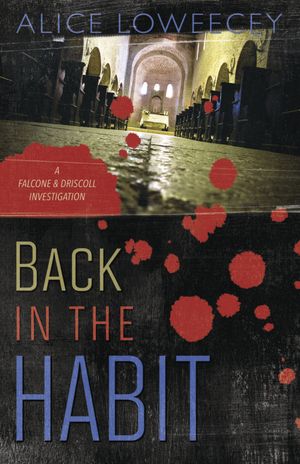
The good thing about the frequent and steep learning curves is that they taught me how to write tight, clean prose with 3-D characters. Those skills helped me get an agent and a three-book deal with the ex-nun Private Eye mystery. You can see their covers here: Force of Habit, Back in the Habit (both in stores now), and Veiled Threat (hits stores 2/8/13).

More characters moved into my head. YA characters.

I’m a mystery writer, I told them. They wouldn’t shut up. I’m a horror writer, I told them. Adult horror. Adult mystery. They ignored me and kept on yammering. I had to shut them up.

Learning curve #3: YA.

And I thought horror-to-mystery was steep and rocky. Hahahahaha!

I broke it down into manageable steps. First: Head to the library and read two dozen current YA books. Because these characters told me they lived in a post-cataclysmic dystopian Buffalo and Niagara Falls, I chose dystopian, paranormal, and UF books.

For one month, I read YA, taking notes on the differences between YA and adult. This placated the characters in my head.

The biggest differences were voice and speed. I’d forgotten that everything is life or death during the teenage years. How important what other people think about you is. How much you obsess over that and clothes and boys and parents and… everything.

The pace of YA is often much faster than adult fic. I saw less introspection and more action. Fewer gab sessions and more Run! Attack! Regroup! Sneak a kiss! moments. Not to say that the latter aren’t to be found in adult fic—not at all. But overall more things happen, and happen faster, in YA.

After I immersed myself in current YA, I returned to my never-fail creation tool: Character Charts. I use the ones from Randy Ingermanson’s Snowflake Method. I have the full version, which was part of my very first large writer’s conference. (Did I say learning curve? That was an eye-opening weekend.)

I start a new book with the MC, his/her love interest/partner, the antagonist, and a short pitch line. When I open the character chart and start with the basics—name, age, height, weight, description—the characters really begin talking to me. They look at the 30-plus items in the chart and tell me what they read and listen to, what they wear and where they work. What their dreams and fear are. This is how I learn about them and the plot—because what they tell me often shows me important plot points.

This was the familiar part of writing YA, because I do the exact same thing for an adult book. So was the next part—writing the outline.

Outlines aren’t for everyone. I pantsed my first book. But once I outlined a mystery, I was hooked. Some writers say that outlining the book from start to finish takes all the excitement out of it. For me, it’s like a basic knitting pattern. I know the measurements, but what I do with yarn and pattern stitches is new every time.

I kept the outline (an Excel spreadsheet) open in one window and the character charts open in another. New characters jumped into the outline as I wrote it, so I created a character chart for them. Items to research got their own column in the spreadsheet. Whenever I got stuck in the plot process, I switched to research.

Learning curve #4: What’s okay in adult fic isn’t necessarily okay in YA.

Yep, that means explicitness. When the book was ready to send to beta readers, they all advised me to tone it down. That meant the language and a few bits of nookie and innuendo that wouldn’t be a problem in an adult book. My agent had me tone it down even further—twice.

While I was still mulling this book over in my head, I talked to some writer friends who wrote extensively in YA. Their unanimous piece of advice was: Get deep into the MC’s head. Which led to…

Learning curve #5: First person.

All my other books (4 at the time of writing this YA) were in close third. I like close third. It’s my preferred reading and writing choice This YA started out in close third, and it was… wrong. The MC wasn’t alive. The story was flat. The dialogue was stilted. Everything stopped with a whump. I realized why a lot of YA was written in first. It lets the reader dive into the MC’s head and experience everything just as he or she is. I realized it worked especially well with YA’s faster pace.

So I looked first person in the eye and said: I will conquer you. I went back to the library and found half a dozen current YAs in first person. I put the WIP away and read all the books. Then I started over.

My MC opened her mouth and her story came alive. Her world, her family, her fears, her dreams. Four months later, I had a finished book. A month after that, I had beta comments and a revised draft to send to my agent.

That book is on sub to editors now—the final step to achieving the Holy Grail: A book deal

The learning curve—curves, plural—were worth it, no question. I’m a more skillful writer because of it. When (never ‘if’!) the YA sells, I have ideas for at least two sequels. Right now I’m writing a paranormal romance with a touch of steampunk. It’s not YA. But my next book could be. It all depends on who invades my head. And I’ll be able to write it because I didn’t back down from the learning curves.

Alice Loweecey is a former nun who went from the convent to playing prostitutes on stage to accepting her husband’s marriage proposal on the second date. Her teenage sons clamor for dramatic cameos in future books, but she’s thinking they’ll make good Redshirts. She is a member of Mystery Writers of America and Sisters in Crime. Visit her website at www.aliceloweecey.com and check out her books on her author pages at Amazon.com and at Barnes and Noble.
Take It Where You Can Find It

Good writing advice can be found in all sorts of places.

This page, for example, features a set of maxims for stage magicians.  Some of them are fairly magic-specific (“Look after your hands and nails. Make sure they are clean or painted”); others, though, hold true for anyone working in the arts and entertainment fields (“Making things as easy as possible for your audience comes before making things as easy as possible for yourself.”)

Though I suspect it never hurt a writer to have clean nails, either.

Another One of the Rough Spots

It’s always a tricky bit when — for reasons necessary to the forward motion of the plot — you have to have one character explain to another character a bunch of stuff that the reader already knows.

This is sort of the opposite of the much commoner “how do I work in the necessary exposition” problem, and tends to crop up in long, complex novels, or in novels where the interlocking plot developments are engineered with clockwork precision, or in parts of an ongoing series.  Unlike the necessary-exposition problem, where the characters already have the required information but the reader does not, with this problem it is the readers who are already in possession of the information, and one or more of the characters who must somehow acquire it.

The trick, to the extent that there is one, is to remember that the reader doesn’t need to be given the information all over again; the reader only needs to understand that the character has been made aware of it.  You can be blunt and direct:  “On Wednesday at lunch, the Director told the Chief of Police everything that had happened during the preceding spring.”  Or you can be more subtle, and have a scene with the Director and the Chief of Police talking over steak and baked potatoes, during which you slip in as much as possible of the known-to-your-reader stuff in indirect discourse, while using the up-front chatter for character and atmospherics and other hopefully-interesting new material.

What you want to avoid is having your reader exclaim, upon  finding out that one of your characters is in possession of a particular piece of knowledge, “But how did he know that?”

Dots and Dashes

Or, This is Not a Guide to Proper Punctuation.

Because where punctuation is concerned, the dirty little secret is that most of the rules are a lot more like local customs.  Different languages have different customary punctuation, and so do different time periods.  Medieval English texts had next to no punctuation at all — once in a while, if the text was meant to be sung or chanted, the scribe might throw in a mark that would someday be a comma or an apostrophe, as a way of saying to the reader, “take a breath here; you’re going to need it.”

Modern editions of older texts — especially the renaissance and medieval stuff — often impose modern punctuation on the material, in the interest of making it more accessible to the reader.  Standardized, or at least sort of standardized, punctuation came in with printing, and it was the printers, not the writers or the readers, who more-or-less codified it.

Even today, there’s a lot more leeway in the area of punctuation than your old high-school grammar texts would have had you believe.  Sure, sentences need to end with a period or a question mark or an exclamation point, and using a comma splice instead of a semicolon is just plain wrong, but when it comes to things like whether to use a colon or a dash, or paired dashes instead of parentheses, or serial-comma-yes versus serial-comma-no . . . you’re on your own.

And don’t worry too much.  You can get away with almost anything, so long as you’re consistent about it.

(Get your dialogue punctuation right, though.  It’s all purely arbitrary, done according to conventional rules that are easy enough to learn and to follow, and to check for errors in the final draft.  And messing them up is likely to put off a potential reader faster than almost anything.)


Looking Backward

Or, the problem with pronouns.

You know pronouns — he, she, it, they, and all those other little words that get called up to fill in for common nouns (cat, dog, gerbil, pigeons) and proper nouns (Tom, Dorothy, Mount Rushmore, the Boston Red Sox) so that our sentences and paragraphs don’t get cluttered up with wall-to-wall names.

The thing about pronouns is that a pronoun is always going to be looking backward toward the noun that it’s standing in for — its antecedent (from a couple of Latinate building blocks meaning, roughly, “falling before”; a pronoun’s antecedent is the word that falls before it in the sentence.)  And  no matter what the actual intended antecedent for a particular pronoun may be ,the reader’s first impulse will be to associate it with the most recently occurring noun of the appropriate gender and number.

Most of the time, re-associating the pronoun with its proper antecedent only takes a fractional second of mental processing on the part of the reader.  The thing is, though, all those fractional seconds start to add up, and the cumulative weight of all that extra time acts like a drag on your story’s forward momentum.  Too much drag, and the reader’s going to get tired and give up.

Don’t let that happen.  Watch your pronouns.