It’s Almost Like Being Respectable

Houghton Mifflin Harcourt – that eminently respectable publisher with eminently respectable bloodlines (I’ve been in this business long enough that I can remember when Harcourt was a separate publishing house) – is adding a science fiction and fantasy volume to its annual Best American series.

This isn’t the first, or the only, annual “Best of” anthology out there; but it’s (maybe the first?  I don’t know that answer) one that’s coming out not from a known genre publisher or fantasy/sf imprint, but from a mainstream house that’s very much into serious literary business.  They’ve also had the good sense to take their series editor ( John Joseph Adams) and the editor for the inaugural volume (Joe Hill) from the ranks of people who are actually working in and familiar with the field, instead of hauling in some college professor or mainstream critic to do the job.

(I have nothing against literary critics or college professors, mind you; it’s just that their taste in fiction tends to privilege those works which provide the best fodder for classroom lectures and articles in academic journals.  Which is not necessarily the same thing as those works which are good.)
More Weird and Nifty Research Links

Have a character who’s going to get arrested in downtown New York?  Check out the Yelp.com review page for Manhattan Central Booking.  (Yelpers will review absolutely anything, apparently.)

Remember Mary Ingalls, who went blind from scarlet fever in On The Shores of Silver LakeWell, it probably wasn’t scarlet fever.

Also — those Norse runes? Turns out a lot of them are also written in code.  And a lot of those coded messages turn out to say things like “kiss me” and “interpret these runes” . . . any day now, they’re going to find one that says, “for a good time, call Gudrun Osvifsdottir.”

And speaking of codes, the mysterious Voynich Manuscript may have been decoded at last — not by cryptanalysts, but by botanists.

Today’s Nifty Link

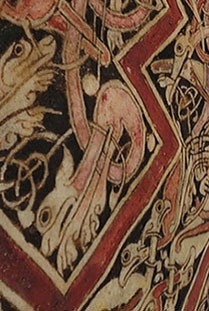
St. Chad Gospel detail

Digitalized images with historical overlays of two manuscripts – the illuminated St. Chad Gospels, dating from about 730 AD, and a Wycliffe New Testament from about 1410 — in the possession of Lichfield Cathedral.

Today’s Nifty Links

Link the first:  A newly-released on-line archive of images from the French Revolution, done as a partnership between Stanford University and the Bibliothèque Nationale de France.  There’s an article about the archive here; the bilingual, searchable archive itself is here.

Link the second:  Over at John Scalzi’s blog, there’s an open comment thread going on, with writers sharing the most valuable bits of practical craft advice they’ve received or read.

From the Good Folks at the OED

Some interesting blog posts about words and related trivia:

There’s one about champagne (did you know that the big 30-liter bottle is called a Melchizedek?) and another about spies (or intelligence officers, as some of them prefer to be called.)

Or have a peevish post on reflexive pronouns (I like this one, myself.)  Or one about OED citations from film scripts and transcripts (the latter for words which appear in ad-libbed dialogue, rather than in the written script.)

Then there’s this one, on the difficulty of translating book titles (Mockingjay gets translated into Spanish with a similar bird-name portmanteau word, Sinsajo, but the German translator opted for Flammender Zorn, “Flaming Fury.”)  Or this one, on German idioms (eine Extrawurst verlangen, “to ask for an extra sausage,” means “to expect special treatment.”)

I could mess around on that site all day.

Links to the Past

Writers of historical or alt-historical fiction are always in search of pictorial references for people and places of times past.  Still pictures are good (and for most of history, they’re all that we have), but for over a century now we’ve had moving pictures, as well – and the internet, bless its digital heart, preserves them and displays them for us at our command.

Herewith, a trio of links:

London street scenes, 1927, in color: http://www.youtube.com/watch?v=Qgxki8_R968

Street scenes from Berlin and Munich, circa 1900-1914, also in color: http://www.youtube.com/watch?v=B-m9A8mY-U0

Driving around New York, 1928.  This one’s in black and white, and is a staged comedy short, but the backgrounds are the real thing.  (And it’s amazing how long some of the visual high-speed automotive tropes we’re still seeing in film and television have been kicking around.): http://www.youtube.com/watch?v=lkqz3lpUBp0

I love the internet.

Buried Treasure!

Buried in a museum, in this case, but treasure just the same.  A lump of “organic material” from a 19th-century archeological dig in Norway had been kicking around the storerooms of the British Museum for over a century before one of the curators noticed a bit of metal sticking out and decided to have the whole thing x-rayed.

His hunch paid off.  Inside the lump of material was a Celtic brooch dating from the eighth or ninth century — six centimeters in diameter, gilded, and decorated with interlaced knotwork patterns.

The whole story, with a picture of the brooch in question, can be found here.

(Obligatory writing reference:  Sometimes it pays to look more closely at the weird lumps of old or unpromising story-stuff that are kicking around your head.  There may be something valuable hidden inside.)

Fun with the Internet

So you’ve promised somebody (or promised yourself, it’s all good) a story, and now you’re stuck?

Try the Cool Bits Story Generator.

A handful of samples:

In Venice, a woman who does the unexpected encounters sailboats as the story begins. As the narrative unfolds, the protagonist meets a tough-as-nails yet likable woman with antiquarian knowledge, and they wind up in an ivy-covered tower with dark passions.

Sounds like one of those buried-historical-secret novels, after the manner of Dan Brown, or Katherine Neville’s The Eight.  Or maybe a thriller having to do with art smuggling.

Your story is a romance between a cynical religious practitioner with a secretly soft heart and a retired superhero. The lovers experience secrecy and the texture of warm stone while in Meiji Japan.

If this one isn’t already a manga, it probably ought to be.

This story begins as a flapper investigates a mystery about a bittersweet romance. Clues include the mythic or archetypal coming alive and love transcending limits. The villain is revealed to be a cat lover, and is motivated out of a need for redemption.

This one is clearly a historical detective story somewhere on the border between paranormal and alternate-historical fantasy, and if somebody were to write it I’d read it in a heartbeat.

I love these things.

Another One from the Department of Nifty Stuff

When it comes to typography, there are people who like to mess around with fonts (I plead guilty as charged) and then there are people who are obsessed with fonts . . . and those people can get just plain weird.

Consider the case of the Doves typeface, created in the late 1800’s for the Doves Press, a small press associated (like William Morris’s Kelmscott Press) with the Arts and Crafts Movement.  The typeface’s creator, after a falling-out with his business partner, dumped all of the type — and the matrices for casting more — into the Thames River, in an effort to insure that no other press would ever use them.  A century later, a digital font designer spent three years working from copies of existing books in the Doves typeface, re-creating the font in digital form.

It’s a fascinating story; you can read the whole thing here.

Another Nifty Thing

People at the University of Turin (and at the University of Pisa, and at the University of Mississippi, among other places) are digitizing the Vercelli Book, and the beta version is now on-line.  The Vercelli Book is the Old English manuscript that contains, among other things, the poem known as “The Dream of the Rood” — “A Vision of the True Cross” would be a more accurate title, in my opinion, but custom is custom.

Seriously, folks, I would have given my eye-teeth for something like this back when I was studying Old English in graduate school.  And the on-line grammars, and the on-line dictionaries . . . I counted myself fortunate, in those days, that I was able to convince my parents that copies of Bosworth-Toller (the big fat dictionary for Old English) and Cleasby-Vigfusson (the equivalent for Old Icelandic) made excellent Christmas and birthday presents.  Given their size and weight, they also made excellent doorstops.

Why are Italian universities spearheading the Vercelli digitization project?  Well . . . the Vercelli Book is called the Vercelli Book because it lives in the library of the cathedral in Vercelli, Italy.  How a collection of Old English poetry ended up in Italy nobody is certain, but it’s been there since the 11th century at least.  (Things became unsettled, to put it mildly, in England during the latter part of the 11th century; it’s possible the manuscript left home at that time.  But nobody knows for sure.)

We’ve come a long way since the days when putting together a grammar or a dictionary or a variorum edition meant working with stacks and stacks of index cards.  God, I love technology.