Link of the Day

xkcd on the use of made-up words in fiction.

He’s basically right, too.  Unless you’re J. R. R Tolkien, and marinated so thoroughly in philology, literature, and Indo-European linguistics that you might as well be writing your novel in Elvish or Anglo-Saxon and translating it into standard English as you go along . . . think twice before adding neologisms to your story’s vocabulary.

But if you have to do it —

Make certain that your invented words can be read and pronounced by an English speaker (if you’re writing in English for an English-speaking audience) with no more than a typical grade-school acquaintance with phonics.  If you’re unsure about any of your words, get somebody else to tackle them cold and listen for what works and what doesn’t.

Compounding your new terms from Greek and Latin roots can provide your story with an erudite or technical flavor.  If you don’t want overtones of the lab or the library hanging about your epic tale, consider making your new words by compounding English terms instead. And needless to say, if you’re bound and determined to use Greek and Latin elements, take the time to get them right.

And in this age of easy internet searches, it wouldn’t hurt to put each of your invented terms through Google Translate and a couple of search engines, just to make certain that you haven’t independently recreated a thundering obscenity in some language you’ve never even heard of (but which will, if you let it stand, turn out to be the native tongue of your most keen-eyed reader.)

Weekend Comma Upcoming

We’ll be at the Burlington, MA, Marriott for Readercon, which we’ll be doing on a relaxacon basis again this year (also on an extremely attenuated shoestring, thanks to the necessity of paying off this past winter’s even-higher-than-usual electric bill.)

One of the things we usually do at Readercon is finish up on Sunday with a summer movie.  I’ve heard some good word-of-mouth about Spy, of the “Don’t let the posters mislead you” variety.  And there’s always Jurassic World, or the latest Terminator outing, either of which would at least provide the requisite summer-move quota of violence and explosions.

In any case, if you’re in or around Burlington this coming weekend, Readercon is a nice place to be.

Thought for the Day

A piece of fiction is a carefully-crafted series of lies told to the reader, which the reader agrees to believe for the duration of the story.  Anything that threatens the fragile nature of this agreement is bad.

This is, for example, why it’s necessary to do your research – if you get something wrong that your reader is in a position to notice, the reader’s ability and desire to continue playing along with you is going to be compromised. The same goes for poorly-motivated characters and plotting by incredible coincidence.

It’s just one of the many oddities of the writer’s craft.  We are, or at any rate ought to be, scrupulously honest and careful about the small stuff, all in service of a bald-faced falsehood:

Listen. I’m about to tell you a true story….

Ah, Summer!

I’d like to say I’ve been on vacation, but alas, the latter half of June wasn’t that entertaining.  Mostly it was spent dealing with assorted mundane but distracting issues like household repairs (ongoing and expensive . . . most of the time, when you live in a big old house, things fail one at a time, but this was the year when everything – including the dishwasher and the hot water heater – decided to go on strike at once), and oppressive weather  (after a prolonged winter, we’re now in the middle of a cool and clammy summer, with all the associated mosquitoes and mildew), and workshop work (reading all the submitted applications, and helping to finalize the roster of admitted students), and writing work (a set of revisions that I’ve been chasing for this long while now like Achilles trying to catch the tortoise.)

But now I’m back, and just to amuse you, a couple of peeves, or at least one peeve and an interesting word pair.

First, the peeve: People, you don’t beckon someone, you beckon to them.

Jill beckoned to Jane.  “Come look at this.”

I see this one even in published material, and can only conclude that either a lot of copy editors are falling down on the job, or a lot of authors are stetting more stuff than they should.

Now, the word pair.

Consider, then, immigrant and emigrant.  These two words can often be used of the same group of people – individuals who, singly or in groups, happen to be relocating from one country to another.  The difference is a matter of point of view.  If you’re standing on the pier and waving farewell as you watch their ship pull away, they are emigrants, people who are traveling from their country of origin to make their home elsewhere.  The clue is in the e- prefix, which comes from the Latin preposition ex, meaning (among a bunch of associated concepts) “from” or “out of.”

If, however, you’re on the other side of the ocean and watching their ship pull up to the pier, the same people are going to be immigrants, people who are coming into a country from somewhere else.  Once again, the  prefix is the key; this time, it’s im-, from the Latin preposition in, meaning “in” or “into.”

(If the same group of people are traveling from one place to another and either don’t intend or are unable to stay in one place, they are simply migrants. As for why the term emigrants should have more positive connotations than immigrants, which in turn has more positive connotations than migrants . . . all I can say is that language is sometimes weird, and people are sometimes jerks.)

Down to the Wire

A timely reminder:  applications for this year’s Viable Paradise workshop close at midnight on the 15th of June – that is to say, this coming Monday.

If you’re on the fence about applying, time to hop off and get your application in the mail!

An Early-June Miscellany

A trio of literary (more or less) links:

“Somewhere in the distance, a dog barked.”  If that line has an all-too-familiar ring to it, you shouldn’t be surprised.  Here’s an article from Slate on the barking-dog trope in modern fiction that will reassure you that you aren’t just hearing things that aren’t there.  If it inspires you to double-check your own stories for gratuitously vocal canines, so much the better.

Which brings us to another literary animal, in this case the dead mule, as encountered in Southern literature.  The dead mule is one of the genre-defining images, like unicorns and spaceships; much as the presence of a spaceship renders a story science fiction, the presence of a dead mule declares it to be Southern.  I don’t know what happens when you have a spaceship and a dead mule in the same story – something by Howard Waldrop, maybe.

And finally, from the editor of Clarkesworld, a list of the most common titles for short stories submitted to the magazine.

It’s Magic!

starcat030513For all you folks out there who are interested in Jim Macdonald’s other artistic vocation (the one that isn’t writing novels), tomorrow and Saturday he’s going to be doing close-up street magic in Bradford, Vermont, as part of the local downtown merchants’ Customer Appreciation Days. Look for him out in front of Star Cat Books – he’ll be the one in the hat.

Road Trip!

Magic Expo SignThis past Saturday Jim Macdonald and I went down to Boston to see Penguin Magic’s traveling expo, which was there that day.  The route and the area were familiar to us, since the Readercon site is in the same general neighborhood, but this time it wasn’t science fiction that brought us there, but Jim Macdonald’s other freelance avocation, stage magic – which isn’t as far a cry from writing sf and fantasy (or writing in general) as one might think.  Both jobs involving entertaining, and sometimes enlightening, the public by creating believable illusions . . . and both of them take a lot of hard work and practice.

Jim had a good time watching the demonstrations.  I don’t do stage magic myself (my job, in my role as Magician’s Significant Other, is to be the test audience and general critic for new tricks, old tricks, and routines under Magic Demodevelopment), but I had a good time anyway.  The event had a lot in common with various other specialized meetups I’ve attended or spectated at in my time – rock and mineral shows, mustache-growing contests, sf and fantasy conventions, and yes, writer’s workshops.  There’s a peculiar pleasure to be had in the company of a bunch of other people who all share the same obsession, and who can be counted on to understand why a person might spend all afternoon working on a new method of cutting a deck of cards, or trying out different ways of punctuating a particular sentence.

(Do I want a comma here?  Would a period and a new sentence work better?  How about two independent clauses and a semicolon?  No, that doesn’t work – the heck with it, why don’t I just cut the whole thing?  Can’t do that either, dammit; it’ll ruin the pacing, and besides, that’s an important bit of information I’m trying to slip in.  Let’s look at it with the comma again….)

Diamonds Magic StockAs is often the case at these specialized events, there’s also the pleasure of cruising the dealers’ tables and trying not to spend more money than one had absolutely budgeted for the purpose.  The setup to the left there belongs to Diamond’s Magic, which is local to the area (up here in the north country of New Hampshire, we count Boston as “local” for certain purposes. Montreal is actually closer, but we don’t need a passport to get to Boston, or at least not yet.)  We highly recommend them for all your magic-related shopping needs.

And a final note:  speaking of specialized groups and shared obsessions and the company of other people who understand why that comma is important enough to spend an afternoon fretting over it:  The application period for the Viable Paradise workshop remains open until 15 June.  If you’re planning to apply, why not get your application in now and avoid the last-minute rush?

Two Peeves and a Link

Yes – it’s grey and rainy outside today, which means that it’s peeve time here in blogland.

Peeve the first:  It isn’t “per say” (though that’s what it sounds like.)  It’s per se, because it’s Latin, meaning “by itself.”  Per is one of those useful prepositions that also shows up as a prefix, usually one that means “thoroughly” or “extremely” or “completely” – probably from one of the other meanings of per-as-a-preposition, which is “through.”  (If you think that’s a wide range of meanings to stuff into a single word, just consider for a minute some of our English prepositions, which let us say things like “He came by himself to the house by the river by car.”  Which is an awkward sentence – I’d flag it in a heartbeat if I ran across it during a revision or editing pass – but not an ungrammatical one.)

But seriously, people, if you’re going to throw in Latin phrases, at least spell them right.

Peeve the second:  Don’t say “this begs the question” when what you mean is “this raises the question.”

Nobody, but nobody, gets this one right, and it drives me batty.  “Begging the question” is the English term for one of the common logical fallacies, also known by its Latin name, petitio principii, in which the person making the argument assumes as true, and argues from, the very thing which he or she is seeking to prove.  (For a fuller explanation, with diagrams, you can look here.)

Finally, to sweeten things a bit after that outburst of peevishness, a link:

The Science Fiction and Fantasy Writers of America 50th Anniversary Cookbook, edited by Cat Rambo and Fran Wilde, is now available for pre-order.  It contains 175 recipes as well as interior illustrations, and is available in both print and e-book formats.

Where I’ve Been When I Haven’t Been Here

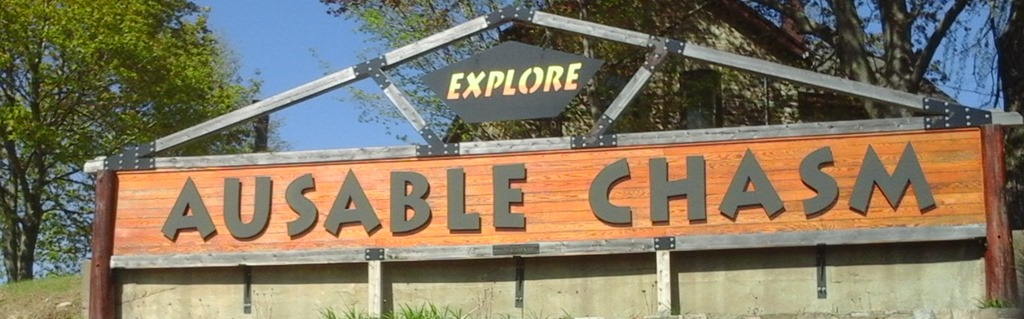
Working, mostly, clearing my way out from under a couple of editing gigs. Our trip to Albacon went well – it was a pleasant local convention with congenial people – and we were able to make a side trip to Ausable Chasm on the way out.

Chasm Sign02

Jim Macdonald (husband and co-author) has had a hankering to visit Ausable Chasm ever since he was a kid and first saw the classic Charles Addams cartoon showing the man and wife at a ticket window, with the caption “A round trip and a one-way to Ausable Chasm.”

Well, this year we finally made it. It’s impressive, even from up on the bank of the chasm:

Ausable Chasm01

All we had time for – we didn’t want to miss the Albacon Ice Cream Social later that evening – was the basic two-hour self-guided trail walk (well, Jim did the trail walk; I, as befits a person who has been spraining my ankles on everything from loose rocks to cracks in the linoleum since I was six years old, stayed up on the bank and enjoyed the tranquility.)  But I suspect we’ll be going back, now that we know what’s there. Both the chasm and the convention come highly recommended – do check them out if you have the opportunity.