Still Snowbound in the North Country

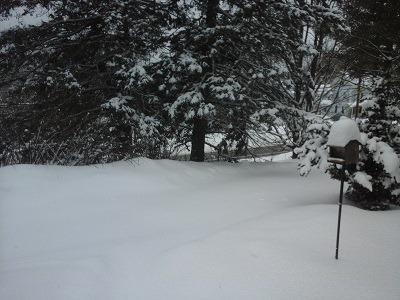
The current snow depth, as indicated by the height of the snow cap on the top of our bird feeder:

SnowDepth

And it’s still snowing.

At least we should have decent driving weather tomorrow for the trip down to Boskone, and the weather down below for the weekend is supposed to be fair and not too cold.

The Unified Doyle & Macdonald Boskone Schedule

Debra Doyle and James D. Macdonald
Autographing
Saturday 14:00 – 15:00, Galleria

(We’ll be autographing alongside Ken MacLeod and Charles Stross, a couple of overseas guests from the UK, so if you’ve got anything by us you’d like to have signed, feel free to bring it in so we won’t let New Hampshire down.)

Debra Doyle
Design Your Own Mythology:
Saturday 15:00 – 16:00, Harbor III

What goes into mythmaking? Panelists share their experiences in creating mythologies and pantheons — offering up dos and don’ts, tips on resources, and things to think about as you try creating a coherent mythology of your own.

James D. Macdonald
From Rapiers to Ray Guns
Saturday 16:00 – 17:00, Marina 1

From epic fantasy to space war, speculative fiction is rife with useful tools and weapons that can be used in battle. How much does a writer or reader really need to know about these weapons for fictional frays to feel real? What weapons work best for close-quarters or downrange combat in specific settings?

Debra Doyle
A Muddle of Mad Scientists
Saturday 20:00 – 21:00, Burroughs

From Dr. Frankenstein to Dr. Faustus, Mrs. Coulter to Dr. Horrible, genre fiction is filled with a long list of the crazily creative geniuses known as mad scientists. Why do we love them? What makes the mad scientist character so appealing in horror, comedy, and everything in between? Join us for a mad, mad discussion featuring some of our favorite screwy scientists/inventors from the past, present, and future.

James D. Macdonald
Abracadabra! Making Magic Real
Sunday 12:00 – 13:00, Marina 1

In writing fantasies — from epic to urban– how do you keep your story’s magic feeling fresh and new? It’s a challenge. Rules and boundaries can help, but how do you make the “science” of the supernatural seem, well, natural? Panelists discuss the perils and potentials of using magic in fiction.

Debra Doyle and James D. Macdonald
Reading Sunday 13:00 – 13:30, Griffin

Snowbound

At least until the driveway gets shoveled clear.  Which is going to be a task which is not mine.

SnowDay

And we have more snow predicted for mid-week.  Fortunately, Friday is projected to be cold and sunny, because that’s the day we’ll be heading down to Boston for the Boskone sf/fantasy convention.  Watch this space for the unified Doyle&Macdonald convention schedule, to be appearing Real Soon Now.

Meanwhile, I have an editing gig to work on, which I have grievously neglected the past two days, because the household was afflicted not only with snow, but with a nasty but fast-moving bug that somehow slipped under this season’s flu-shot radar.  (Better last week than this coming weekend, is all I can say.)

This Just In

Self-publishers and cover designers take note:  The Metropolitan Museum of Art has placed “more than 375,000 images” from its online collection into the public domain for free and unrestricted use.

Which is a bit of good news to brighten up what is – at least up here in far northern New Hampshire – a grey and snowy day, in a generally grey and dispiriting season.

Winter Comes, Every Year

And so do the winter electric bills, because we heat our (big, old) house with electricity.  We used to heat it by means of a wood-burning forced-hot-air furnace in the basement, but gave that up after about a decade and a half – wood is cheap, compared to other locally available heating methods, but it’s a hassle from start to finish.

First you have to purchase the firewood, which means finding a reliable Firewood Guy – something that’s a lot harder than you’d think, because your typical reliable Firewood Guy is usually just one year away from selling his chainsaw and his skidder and retiring to Florida, so calling last year’s supplier almost never works.  Once you’ve got the firewood, it has to be stacked, all eight or nine cords of it (a cord, if you’re interested, is a stack of logs measuring 4’x4’x8’, and if you’re ever in the business of purchasing cordwood for yourself, make certain you specify “full cord”, because unscrupulous dealers are not above selling you so-called “face cords” which are only half the width of a proper cord.)

Then the stacked wood has to be heaved down into basement where the furnace lives; this will have to be done repeatedly throughout the winter, usually in the dark on bitter cold nights, because that’s always the time when one or another of the house’s occupants comes into the office and says, plaintively, “There’s no more wood in the basement and the fire is getting low.”  At which point somebody – probably you, because why else would they have come into the office to complain about it – has to suit up in full north country outdoor gear and go move some logs.

After that, you have to go down into the basement and heave yet more logs, this time from the basement into the furnace.  And you’ll have to do it again before you retire for the night, and as soon as you get up in the morning (forget about sleeping in, if you heat with wood), and every four or five hours throughout the day.

So once I started having paranoid fantasies about chimney fires, and about the insidious threat of carbon monoxide, and about tripping and falling on the rickety basement steps – but especially about the basement steps, because I have the sort of ankles that can turn on a crack in the kitchen linoleum – I said the hell with this, and switched to the backup electric baseboard heat.  I have dreams of converting the house to oil or propane, because all the ductwork is still in place, but a project of that expense and magnitude would require major money up front, and Hollywood hasn’t bought one of our novels yet.

Which is why one of the early posts on this blog, back when I was just getting started, was my Fire in Fantasy Rant, and why I’m taking this opportunity to point a discreet finger at the Editorial and Critique Services link up there above the header.  If you’ve got a novel in need of editing, you have it in your power to help me make the electric company very happy.

Magic Shop Needs Help

Over at his blog, Jim Macdonald re-posts an appeal to stage magicians and illusionists on behalf of a Baltimore magic shop:

jamesdmacdonald's avatarJAMES D. MACDONALD

To all my terrific customers!

Just got this note from our pal David Oliver. I am asking every one of you as a favor to one who has always been a friend and mentor to all magicians, Denny Haney, to please do  what you can to help one of the few truly great magic stores in this country.

THANK YOU!

From David Oliver:

I have known Denny Haney, of Denny & Lee’s Magic Studio in Baltimore for over  twenty-five years. Denny is one of the most knowledgable magicians I have ever known, as well as being one of the most giving. He always helps young magicians starting out, and older magicians looking for information or tips. His background in magic is astounding, and he is one of the few who is universally respected in the industry. He’s just a GREAT guy. He’s run into a bit of financial trouble, and…

View original post 344 more words

Peeve(s) of the Day

Because this is a season for feeling peevish about so very many things.

Peeve #1:  The phrase is not “been through the ringer” – it’s “been (or put) through the wringer”, with a wWringer comes from the Old English wringan, meaning “to press, strain, wring, or twist”, and it refers to a now pretty much obsolete laundry appliance used to extract the water from clothes that have been washed.   (But if you really want one, Amazon will sell it to you.)

So looking like you’ve been “put through the wringer” means that you look like you’ve been pressed flat between the appliance’s upper and nether rollers and squeezed dry.

Which is how a lot of us feel these days – I can’t imagine why.

Peeve #2:  “Diffused” and “defused.”  Something is diffused when it is dispersed or spread out over a large area or in a large volume of something:

The smoke from the burning incense was diffused throughout the room.

Something is defused when it has had its fuse removed, often in order to prevent it from doing something undesirable, such as exploding.

The bomb tech defused the explosive device.

  Metaphorically speaking, something is defused when somebody does or says something to reduce the tension or head off unpleasantness:

The dinner-table conversation on Christmas Day was on the verge of turning into an argument, but Jane defused the situation by bringing out the plum pudding and setting it on fire.

Because there’s nothing like a little creative arson at the dinner table to redirect people’s attention.

I Like Reality…

Jim Macdonald waxes political again, over in his blog.

jamesdmacdonald's avatarJAMES D. MACDONALD

…I live there.  It’s where I keep my stuff.


Now comes the news that Trump pressured Park Service to find proof for his claims about inauguration crowd

On the morning after Donald Trump’s inauguration, acting National Park Service director Michael T. Reynolds received an extraordinary summons: The new president wanted to talk to him.

In a Saturday phone call, Trump personally ordered Reynolds to produce additional photographs of the previous day’s crowds on the Mall, according to three individuals who have knowledge of the conversation. The president believed that the photos might prove that the media had lied in reporting that attendance had been no better than average.

“No better than average” is being kind: by all available metrics the crowd at Trump’s inauguration was smaller than that for not only Obama (only about a third of the size) but for George W. Bush and Bill Clinton.

As I…

View original post 146 more words

Things Seen and Unseen

Let’s talk for a minute about point of view. In fact, we could talk about point of view for considerably more than a minute, because it’s a complex and many-layered thing – not to mention being, for some writers, the key to making everything else click into place. (For other writers, the key might be something else. Nothing about this job is universal, except maybe that if you don’t write you won’t ever have written.)

I’m assuming right now that if you’re reading this you’ve already absorbed Point of View 101: Third Person, First Person, and the Weird Stuff. (I’ve blogged about those already, here and here, if you want a quick refresher.)

What I’m thinking about now is a bit more subtle – it’s one of the failure modes of point of view.  Point of view is implicit in a narrative, even if it isn’t directly specified, and sometimes the narrative “sees” things which nobody is observing.  This results in clumsy writing, or in writing which, while not precisely clumsy, nevertheless has an off-center sort of wrongness to it that can have a cumulative effect on the reader’s sense of immersion in the story.

An example:

As Joe looked at the kitchen door, it was angrily thrown open.

There are a couple of things wrong with that sentence, starting with having the active observer relegated to a subordinate clause, and the important action – the throwing-open of the door – occurring as an agentless passive verb. (Who is throwing open the door? The narrative doesn’t let us see them.) Those wrong things, though, are made worse by the point-of-view failure we get in that adverb “angrily.”

Anger is an emotion, a state of mind; somebody is experiencing it as he/she/they throw open the door.  But we don’t see the door-opener, so we’re not in a position to draw inferences about their state of mind.

Fixing that sentence requires either showing us who is on the other side of that door – As Joe looked at the kitchen door, Jane angrily threw it open – or replacing “angrily” with a verb, or verb+adverb, that doesn’t have an implied state-of-mind attached – As Joe looked at the kitchen door, it was abruptly thrown open/jerked open.  (In this case, I’d probably go with the latter fix; that is, if I didn’t decide to rewrite the whole sentence from scratch, and possibly the paragraph it was part of as well.)

In a similar vein – don’t refer to a character as holding onto something with a white-knuckled grip if that character is wearing gloves.  Nobody, including the character, can see the knuckles in question.

As a general rule, when you’re writing description, it’s always good to pause every so often and query yourself:  Where is the (named or just implied) viewer standing?  Is everything you’ve just mentioned visible from that point?  If you’re doing the verbal equivalent of a tracking or panning shot, is your observation moving smoothly from point to point, or is it jumping around at random?*

Point of view may not, as I said at the beginning, be the key to everything.  Nevertheless, if you’ve got a good handle on point of view, you’ve probably got most of your other ducks lined up and quacking in formation as well.

*Yes, there may be occasions when you want a sense of jumpy and random observation.  But there, too, point of view rules:  your reader is going to draw inferences from that jumpiness about your observer’s probably-confused state of mind.
Fifty Shades of Grape

Over at Jim Macdonald’s blog, he takes on a forthcoming movie and a popular, not to say notorious, book:

jamesdmacdonald's avatarJAMES D. MACDONALD

I see from the posters outside my local cinema (local = forty-five minute drive in good weather, assuming no logging trucks) that the sequel to Fifty Shades of Grey is about to hit the screen.

As it happens, a while back I watched the first Fifty Shades movie on DVD, because, among other things, the book had sold a million-bajillion copies and I too want to sell a million-bajillion copies of my books.  I’m told that the movie was a reasonably-faithful line-by-line/scene-by-scene transfer of the book to screen.

The movie contained a number of protracted and deadly-dull sex scenes, which were scored with insipid and deadly-dull background music.  I discovered a way to improve them.  First, turn off the sound on the video.  Substitute either “The Song of the Volga Boatmen” or “The Song of the Horse-Drawn Machine Gun Cart.”  (This also helps with the movie’s various protracted…

View original post 440 more words