My offspring, they have a podcast:
It’s up at all the usual places.
(“Art in the blood, Watson . . . .”)

My offspring, they have a podcast:
It’s up at all the usual places.
(“Art in the blood, Watson . . . .”)
In a sane and rational world, it shouldn’t be necessary to state for the record that I thoroughly disapprove of alt-right supporters neo-Nazis white-supremacists dirtbag racist whackaloons holding torchlit rallies, chanting racist slogans, beating up counterprotesters, and ramming cars into crowds of people with murderous intent.
It would be the sort of thing that any person of normal intelligence and good will should be presumed to be against until proven otherwise.
But that’s not the world we live in, so . . . let it be known that I thoroughly disapprove of all of the above things.
Congratulations to everyone I know and like who got a Hugo!
And congratulations to everyone whom I don’t know personally, but still like, who got a Hugo!
Looking over the results, I don’t think there’s anybody whom I know well enough to dislike who did get a Hugo (unlike some years past), so that’s good, too.
It’s nice to see that science fiction’s signature award is still doing well.
 That tree in the front driveway that I was talking about the other day is now showing its first patch of color. Summer is now officially (for local household values of “official”) transitioning into autumn.
We have also recently taken in our first batch of gift zucchini. Likewise a couple of locally-grown tomatoes, which promptly went into BLT sandwiches. Raising tomatoes up here in northern New England is a triumph of hope over experience every time; they have to be started indoors, and once they’re out in the garden, it’s a race between them and the first frost.
(A harbinger, by the way, was originally a person who went ahead of an army to arrange for lodgings, going back through Old French to Old Saxon to a couple of root words heri and berga – meaning, respectively “army” and “a fortified place.” The latter is the same root that shows up in a lot of place names, since for a long time, historically speaking, “city” and “fortified place” were more or less synonymous.)
Our printer died the other day, somewhat to our surprise. It was an HP Deskjet 6940 — in other words, a fairly sturdy office model — and it really shouldn’t have reacted so badly to having been taken for a car ride to Peabody, Massachusetts, and back again. But react badly it did; once reconnected to our household setup, it steadfastly refused to communicate with the desktop computer.
We did all the usual things to confirm its defunct state: We switched in a known good USB cable, to make certain it wasn’t the cable, and it didn’t work; we switched in an old but working college printer left behind by one of our various offspring, and it did work, to the extent that it would install and communicate with the desktop computer (it had paper take-up issues, and its ink cartridges were several years old, so it wasn’t good for anything other than diagnostic purposes); we ran all the troubleshooters and checked for updated drivers; all to no avail.
It was time, we admitted, to go printer shopping, and so we did. I wound up ordering a refurbished Kodak Verite 55 from New Egg; I’ve had good luck with their refurbished stuff before. Also, the printer in question was on sale that week for $34.99, which meant that even if it turned out to be a dud, I wouldn’t be weeping hot tears over its demise. Nor would I feel unduly guilty if we decided at some more wealthy point to upgrade to a more expensive model.
The printer in question is low-end enough that by the time we’ve gone through a couple of replacement ink cartridges, we’ll have spent more on ink than on the machine itself. (It’s the “don’t make your money selling razors; make your money selling razor blades” principle, I suppose.) But it doesn’t matter. We don’t actually need an iron-thewed workhorse of an office printer that can do 600-plus pages in an afternoon without breaking down, because it’s been over a decade since we last submitted a novel in hardcopy form.
It’s all electronic now, and I don’t miss it a bit — not the wrestling with a stack of loose paper that wants to slump over into an uncollated pile; not the necessity of keeping an eagle eye on the printing process to make certain that no blank pages or skipped pages get through; not the wrestling with paper jams or the inevitable discovery at page 550 that you’re out of ink and the nearest Staples is an hour and a half away and already closed for the night.
Other people can wax nostalgic over their old-school office-quality printers†, or their IBM Selectrics or their Smith-Coronas, or their one true fountain pen, or their perfectly-trimmed goose quill, but not me.
In this case, at least, technology is my friend.
†Okay, I’ll admit to looking back at my first Epson MX-80 dot-matrix with fond remembrance; that printer was built like a tank, and survived both a transcontinental move and an international move without failing, and was our printer of choice for first drafts for a long time after that.
Jim Macdonald did magic again last weekend, and over at his place, he blogs about it:
(With bonus writing-related content!)
Any day now, though, the maple tree by the foot of our driveway will show its first patch of color. August up here is almost as much the start of autumn as it is the last of summer, and I wouldn’t have it any other way. I lived for long enough in Texas, where July and August are fry-an-egg-on-the-sidewalk months; and I spent three and a half years in the literal tropics when my husband/co-author was in the Navy and stationed in Panamá, where you got a choice between hot and rainy and hot and not-rainy (but still humid), six months on and six months off; and believe me, seasons are good, and New England seasons suit me fine.
(Granted, January and February are a frozen hell, but my theory is that no matter how much you like the climate where you are, there are going to be a couple of months out of the year when you pay for it.)
My favorite seasons, which also happen to be the best ones for writing in as far as I’m concerned†, are spring and fall, both of which proceed up here in a leisurely fashion, with subtle gradations along the way. Fall, for example, goes through early fall and first frost to peak color to waiting for the snow-that-sticks, and runs roughly from mid-August to late November.
Meanwhile, it’s summer, and any day now I expect that the local gardeners will be palming off their excess zucchini (there appears to be no middle ground between no zucchini and too much zucchini) on anyone who will take it, and I will be making lots of zucchini bread.
†Obligatory writing reference!
Today is the anniversary of a couple of iconic events from the Wild West: One of the first, if not the first, actual middle-of-the-street quick-draw gunfighter duels, and the first train robbery by the Younger-James gang (not the first train robbery of the Old West, though — the Reno brothers beat Cole and Frank to the draw, as it were).
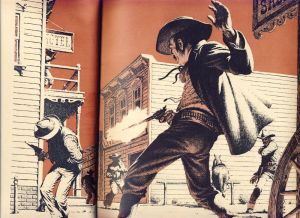
The duel was between Wild Bill Hickok and Davis Tutt on 21 July 1865 in Springfield, Missouri. The quarrel between the men was over (possibly) unpaid gambling debts and (perhaps) over the affections of one or more young ladies. The most proximate cause, however, seems to have been Tutt parading around town wearing Wild Bill’s gold watch (which Tutt had either stolen, or was holding as collateral for one of the aforesaid gambling debts).
They really did square off in the middle of the street, and at a range of…
View original post 202 more words
Reblogged from Jim Macdonald’s blog:
The results of the first annual Granite State Magicians’ New England Magic Contest, held last Sunday in Peabody, MA:
Congratulations to all our contestants!
No one died, no one stabbed themselves in the hand, and no one is in jail. Therefore, success!
In Other News:
A couple of photos of handsome young me busking at Farmers’ Markets:
My schedule
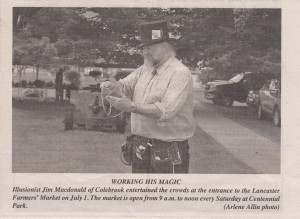 At the Lancaster Farmers’ Market
Photo from the North Woods Weekly
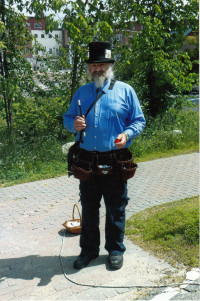 At the Littleton NH Farmers’ Market
Today’s peeve, because I haven’t been peevish for a while:
Listen up, people. The phrase you’re aiming for isn’t “make due.” It’s “make do.”
I know that homonyms are tricky, and “do” and “due” are homonyms in some dialects of English.† (My own native dialect isn’t one of them; the vowel sounds are different enough that I’m not likely to confuse the two. On the other hand, if I don’t specify either a fountain pen or a safety pin, a listener with no context to help out won’t know which one I’m talking about.)
Still, that’s no excuse for not getting it right in your prose. It’s the sort of mistake that puts off discriminating readers, and you don’t want to do that.
And now the “plus” part of this post, or, I discover a tasty new thing to do with cabbage.
The thing is, I like cabbage. I once – no lie – cut a class when I was an undergrad, purely because the college cafeteria that fed my dorm was going to be serving braised cabbage that day, and I wanted to get there when the dining hall opened so that I could have it fresh instead of after it had been sitting on a steam table for an hour and a half. (The class was Eighteenth Century English Lit, and Edward Young’s Night-Thoughts – the work assigned for that session – simply couldn’t compete. The eighteenth century was a great time for English prose, but for poetry, not so much, at least not until the Romantics came along.)
Anyhow, I like cabbage, but after steaming it, and braising it with kielbasa, and chopping it up and putting it into slaw, I thought I’d run out of ways to cook it. Then I read online about roasted cabbage, and I said to myself, Self, you need to try this one.
It’s one of those dead simple recipes: Take a head of cabbage, a cutting board, and a nice heavy knife. Slice the cabbage longitudinally into one-inch thick slices – cabbage steaks, if you will – leaving in the core.
Meanwhile, preheat the oven to 400° F.
Then take a sheet pan and line it with tinfoil (another lovely word – tinfoil hasn’t been made of tin since the middle of the last century). Spread a couple of tablespoons of olive oil over the bottom of the pan. Put the cabbage slices on the sheet pan in a single layer, and brush them with more olive oil. Then sprinkle the slices with fresh ground pepper and kosher salt.
Put the sheet pan in the oven, and cook the cabbage for 40 minutes, turning them over carefully at the 20-minute mark.
Serve as a vegetable with grilled sausage or whatever pleases you.
†Everybody speaks a dialect of some sort. It’s just that some dialects are more privileged than others, and get to be called “Standard.”

 Dr. Doyle's Blog