The I’s Have It

As a general rule, when you’re writing in first person, it helps to know the narrator’s assumed reader or listener – that is, the fictional person or persons that your fictional speaker is speaking or writing to.  Some first person narrators sound like a person telling their story to a single curious listener, at some comfortable time after the fact; some sound like they’re addressing a group; others use devices such as diary entries, voice recordings, letters, and the like to suggest that the story is being assembled or recorded for posterity in some fashion.

Some first-person voices are hallowed by tradition.  There’s the reader-I-married-him voice of the Gothic novel, as exemplified by Charlotte Bronte’s eponymous narrator in Jane Eyre, and by the never-named heroine of Daphne DuMaurier’s Rebecca.  There’s the noir-tinged private-eye voice of Dashiell Hammett’s Continental Op, or Raymond Chandler’s Philip Marlowe; and the confessional voice of the contemporary memoir.

The first person is not without its pitfalls, however.  Some readers hold it in visceral disregard, often so intense that they simply will not read a story if they see that it’s written in the first person.  Other readers react badly to dissonance between the perceived gender of the narrator and the perceived gender of the author.  They are unable or unwilling to suspend their disbelief long enough to accept a male narrator in a story with a female by-line, or vice versa.  And if you’re planning to kill off your viewpoint character in the end, first person will make it a hard sell.

(Well, you could always have the story being narrated by their ghost – it’s been done before – but it’s tricky to do that and still maintain suspense.  Also, some portion of your readership will inevitably be disgruntled at what they perceive as an underhanded bit of literary trickery.)

As always, weigh what you want to accomplish by using the first person against what you may lose if you don’t pull it off as well as you’d like, or if some portion of your readership is put off by it, and make your choice accordingly.
 

Three Nifty Links and a Brief Reminder

Commas are important tools in the ongoing struggle for (and sometimes between) clarity and euphony – so important that it’s easy to lose sight of the fact that, even more than most punctuation marks, commas are pretty much a local-option kind of deal.  The conventions for comma usage vary from one language to another, as I learned to my sorrow back in the days when I was learning Old English and working with a lot of OE texts that had been edited by German scholars and therefore punctuated with German punctuation.  (It’s a mark of where I learned a particular language and how I mostly used it that my rudiments of German are mostly stuff like “The following forms appear only in the dative plural,” while my fragmentary Spanish runs mostly along the lines of “Do you have Tylenol in drops for infants?”)  Comma use also varies from one century to another, and from one writer to another – some writers prefer to deploy their commas strictly according to grammatical rule, whereas others prefer to use them according to the rhythm and the phrasing of the sentence.

Under the circumstances, it’s not surprising that some people take their commas very seriously indeed.

Over in another corner of the internet (the internet has many corners), Slate columnist Derrick Johnson strikes a blow against e-mail address snobbery when he explains why he still uses his AOL e-mail account.  (Hint: because it still works just fine.)

Meanwhile, for the folklore and folk music enthusiasts among us, here’s the Vaughn Williams Memorial Library.

And finally, the reminder:  the Dr. Doyle’s Editorial Services Springtime Seasonal Special closes at midnight this coming Saturday, April 11.

Springtime Seasonal Special

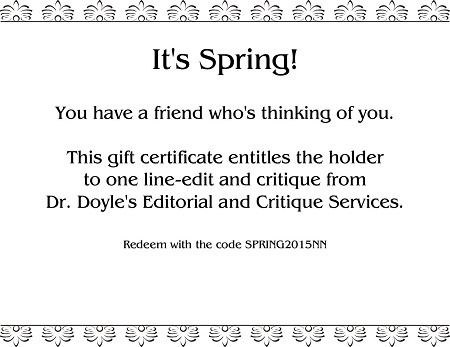
From now through the 11th of April, in honor of the arrival of new growth and brighter days, my usual rate for a full line-edit and critique drops back to $1000.  Furthermore, you can purchase a gift certificate for a friend or colleague at the seasonal price, to be redeemed by the recipient at whatever future date they find convenient.

Sample Spring Gift Certificate SmallPic

The gift certificate comes in the form of a .pdf file suitable for printing out and enclosing in an envelope, or putting into a gift-wrapped box.

(And if the person the gift is meant for happens to be you—that’s perfectly fine with me.)


The Problem with Nice

If writing effective villains is hard, writing effective nice characters is even harder.  Villains do things; they are proactive in pursuit of their evil goals.  They are objects in motion, and objects in motion draw and keep interest.

Nice characters, on the other hand, are all too often defined by the things they don’t do:  they don’t start fights; they don’t break their own marriage vows or go after the significant others of their friends; they don’t nurture long-term obsessive plans for gaining revenge or accumulating wealth or attaining positions of power.  They may not even smoke, drink, or listen to rock-and-roll (and the strongest drug they take is probably aspirin.)  If you make your readers spend too much time around a character like that, they’re going to start cheering for the villain.

Something to keep in mind, then:  If you want characters to generate plot and conflict, they need to have shadows in them to hide stuff and angular bits to catch on things.

Today’s Bit of Amusement

Over at The Toast, “How to Tell if You Are in a Logic Puzzle.”

Because heaven knows, Logic Puzzle Land has only a tangential relationship to Real Life Land.

Obligatory writing reference:  When constructing plots and figuring out character motivations, remember that Fiction Land generally strives to reflect Real Life Land, not Logic Puzzle Land.  There are a few instances where it’s closer to Logic Puzzle Land – the strict-form allegory, for example, or the roman à clef – but those are the exceptions rather than the rule.

(Now that I think of it, that’s a good way to distinguish between an allegorical work and one that merely makes heavy use of symbolism and metaphor:  If the workings of the plot and the actions of the characters appear to be taking place in Logic Puzzle Land, you’re probably dealing with an allegory.)

It’s January

Which means that applications are now open for Viable Paradise XIX, being held this year on 18-23 October at the Island Inn on Martha’s Vineyard, Massachusetts.

Come for the workshop; stay for the lighthouses, the luminescent jellyfish, and the really excellent seafood.

Also:  I’m currently putting together the January issue of my newly-inaugurated newsletter.  If you’re interested in receiving what should be a monthly e-mailing, you can sign up via the link in the sidebar, or click on it here.

Writing for Joe’s Beer Money

The idea that creators of popular fiction are writing for “Joe’s beer money”* is an often derided concept, but in my opinion it shouldn’t be.

For one thing, the fact that Joe is reading for pleasure at all should be celebrated, not sneered at.  Elitists might be surprised at what Joe sometimes picks – it isn’t just thrillers and soft-core porn.  I remember stopping for coffee for once at a truck stop that had, in addition to the usual snack foods and sundries, a wire spinner rack filled with audio book rentals for pick-up-and-drop-off .  One of the more well-worn items on the rack was an audio book of Homer’s Iliad.

For another thing, writing for Joe’s beer money is demanding work.  Joe doesn’t make so much money that he wants to finish a book feeling like he threw away some of it on a thing he didn’t enjoy.  (And let me say right here that Joe is just as capable as anyone else of acknowledging different values of enjoyment.  See Homer’s Iliad, above)  Furthermore, Joe is honest:  He’s not going to pretend he liked your book just to impress his friends and co-workers.  But if he does like it, he will read your next one, and probably the one after that.

Also – oddly enough, the cost of a mass-market paperback novel and the cost of a six-pack of ordinary beer have stayed roughly equivalent at least since the 1970’s, which is about the time when I started keeping track.  (Of paperback prices, at any rate.  I had to go to the internet for the beer data.)  Trade paperbacks are more in line with the cost of imported and craft beers; and it’s entirely possible that part of the controversy over how much an e-book should cost is also a disagreement over whether an e-book is more like a six-pack of Budweiser or a six-pack of some five-star brewpub’s signature XXX Strong Ale.

*The original quote is often attributed to science fiction writer Jerry Pournelle.

The Muse at War

It’s possible to go through an entire writing career without having to send your characters off to war.  But even in the most unlikely of genres – “sex and shopping” summer beach novels, or literary novels set in darkest Academe – an unexpected plot turn can have your characters heading for the sound of the guns (or the clash of swords, depending upon the era and the tech level), and next thing you know, there you are, smack dab in the middle of a pitched battle.  You may even, if you’re working in some of the more speculative genres, have to make up a battle from scratch.

How, then, to make the ensuing military engagement, if not realistic, at least credible?  There are a couple of reliable ways.

One way, of course, is personal experience.  If you have it, you know already that you do, and you might as well get all the use out of it that you can.  About the only thing you need to remember is that fiction has to be believable, whereas reality is under no such constraint.

The other way, of course, is research.  There’s research done the slow way, when you read political history and military history and Sun Tzu and Clausewitz and the memoirs of a lot of people who got out of their various wars alive and wrote about them afterward, and play a lot of war games and maybe do some historical re-creation on the side, and then put all of that together to synthesize your battle.

Then there’s research done the fast way, where you steal a battle outright.  This is especially useful when the military aspect of the plot isn’t the main thing – maybe you’re more interested in the romance, or the politics, or the class/race/gender/whatever issues – but you’ve nevertheless found yourself in a corner of the story where the only way out is through this enormous set-piece battle that you somehow have to write.

What you do, at that point, is pick a historical battle from roughly the same era-and-tech-equivalent as your fictional one, and shamelessly use the terrain and maneuvers and eventual outcome of that battle as the template for your own.  It helps to pick a relatively obscure engagement – more people than you suspect are likely to recognize the double-envelopment of Cannae, or the defense of Little Round Top at Gettysburg – and to pick a single point of view character and stick as much as possible to just what he or she is experiencing.

And then you don’t tell anybody what battle you stole.  If some fan writes you a letter, or corners you at a convention or a book signing, and says, “Hey – wasn’t that space battle in Book Two of your trilogy a rip-off of the Battle of the River Plate, only in space?”, you can give them a big smile and say, “Why, yes, indeed!  How clever of you to notice!”

Seasonal Special from Dr. Doyle’s Editorial and Critique Services

In the spirit of making the Yuletide (or other seasonal holiday of your choice) a bit brighter all ‘round:

From now through Twelfth Night (5 January 2015), my price for a full-dress line-edit plus a 3-5 page letter of critique drops to a flat $1000 for a standard-weight novel.

This offer can also be combined with the Seasonal Gift Certificate I blogged about earlier.

Giving Thanks

Things I’m thankful for, as a writer:

  • The word-processor/printer combination, a wonder of modern technology that’s eliminated so much of the sheer physical drudgery of turning a story into submittable text.  There are probably writers out there, these days, who never had to wrestle with an electric – or worse, a manual – typewriter and a ream of 20-pound bond paper and a bottle of white-out, making mental calculations all the while as to exactly how many corrections they could get away with on the finished page before having to trash it and start over.  I do not miss those days at all; as soon as I could afford the tech, I was there.
  • The internet, which in addition to supplying us with distractions such as cat pictures and “Which Classic Dessert Are You?” quizzes, also brings the resources of great museums and research libraries to our homes and offices.  Books and pictures that we would otherwise have needed to drive for miles just to take a look at, are now ours for the click of a mouse, as is expert advice on everything from high fashion to horsemanship.
  • The e-book revolution, which bids fair to do for reading in this century what the paperback revolution did for it in the last one.
  • And, of course, all the friends and colleagues and readers (including, of course, you) who are a source of kindness and good company in what is, of necessity, a mostly solitary occupation.