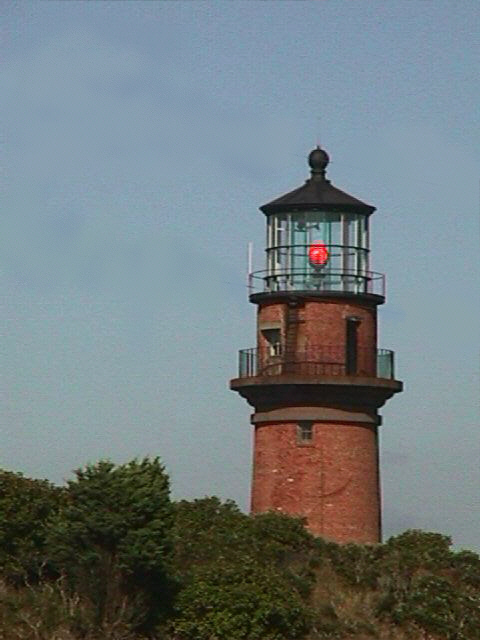
Back from Martha’s Vineyard…

…and we’re already contemplating another road trip.  This one, thankfully, is briefer:  a jaunt down to Toadstool Bookshop in Peterborough NH for an Impossible Futures booksigning, this Saturday the 26th.

More regular posting about life, literature, and the things that peeve or fascinate me will resume shortly.

Where I Have Been

gay head wirelessI’ve been — still am, and probably won’t be at home with my main machine and good connectivity until sometime Monday — on Martha’s Vineyard with the Viable Paradise workshop, which is an intense and often transformative experience, even for the instructors.  Spending a solid week talking about almost nothing except writing, because even the conversations about everything else tend to circle back to writing in the end, is energizing in the very best way.

Things learned this year include:  sliced potatoes baked with sea salt, olive oil, and rosemary are the food of the gods; moments of sudden insight strike people in all sorts of ways; Shakespeare’s The Merry Wives of Windsor may well be the filthiest play ever written, and also one of the most hilarious.

Applications for next year’s VP open on 1 January 2014.

Tell Me, Dr. Doyle…

…why aren’t you posting very much this week?

Because I’m on the island of Martha’s Vineyard, getting reading to be one of the instructors for this year’s Viable Paradise Writer’s Workshop.  The workshop is a great deal of fun, but it’s also a great deal of work — it takes up not just time, but mental processing power.

For your amusement, though, have a nice rant about MS Word from science fiction writer Charlie Stross.  I’m a WordPerfect fan myself (they will take away my Reveal Codes window when they pry it from my cold dead fingers), but I use Word for my editing work because just about everybody else uses it; either that, or they use some obscure personal favorite and export the files to Word when they want to share them.   I don’t think anybody really likes Word; at best, they feel about Word the way I feel about Windows computers . . . they do what I want, and nobody expects me to be in love with them.   (Say bad things about Windows, and nobody cares.  Say bad things about the Mac interface, and the Mac users make sad puppy eyes at you because you’re being mean.)


Thought for the Day

Discovering traces of flawed humanity in an idol of one’s adolescence is a shocking thing; one almost never forgives the idol for being, after all, as imperfect as the rest of us.

This is, possibly, why YA authors in particular can draw such strong negative reactions if they stray in some fashion from the path of virtue:  Their former fans can still remember that early rush of uncritical admiration, and — now that they’re all grown up and are trained readers and everything — it embarrasses them.

Some Things Never Change

The life of the artist has always been a precarious one, financially speaking.  Geoffrey Chaucer was not exempt from its ups and downs.  The Canterbury Tales poet depended for cash on annuities that had been granted to him by Richard II, and when Henry IV took the throne in a regime change that ended with Richard II dying in prison, Chaucer was understandably concerned about the continuation of his stipend.

Reminding a king that he owes you money is tricky under any circumstances; doing so when the money was promised to you by the recently-deposed previous monarch is something beyond tricky.  Fortunately for Chaucer, he had an in:  His wife Philippa was the sister of Henry IV’s father’s last wife (and long-time mistress) Katharine Swynford, which made him sort-of family.  Close enough, at any rate, that Chaucer felt he could get away with giving the new king a gentle nudge.

So here’s Chaucer, addressing not the king, but the artist’s true love, his currently-flat wallet:

To yow, my purs, and to non othir wyght
Complayne I, for ye ben my lady dere!
I am so sory, now that ye been lyght;
For certes, but yf ye make me hevy chere,
Me were as leef be leyd upon my bere;
For which unto your mercy thus I crye,
Beth hevy ayeyn, or elles mot I dye!

Now voucheth sauf this day, or hyt be nyght,
That I of yow the blisful soun may here,
Or se your colour lyk the sonne bryght,
That of yelownesse had never pere.
Ye be my lyf, ye be myne hertes stere,
Quene of comfort and of gode companye;
Beth hevy ayeyn, or elles mot I dye!

Now purs, that ben to me my lyves lyght
And saveour, as doun in this worlde here,
Out of this towne helpe me thurgh your myght,
Syn that ye wylle nat ben my tresorere;
For I am shave as nye as any frere.
But yet I prey unto youre curtesye,
Beth heavy ayeyn, or elles mot I dye!

Lenvoy de Chaucer

O conqueror of Brutes Albyoun,
Which that by lyne and fre eleccion
Ben verray kyng, this song to you I sende;
And ye, that mowen alle oure harmes amende,
Have mynde upon my supplicacioun.

The poem worked; Chaucer got his money.

(For a modern English translation, go here; it’s the fourth poem down.)

The Better Part of Valor

As a matter of principle, I believe that a writer should be free to pick his or her subject matter from the entire range of human experience — even when the premise in question is such that, if it were an objective in one of the tabletop Squad Leader games I used to play, it would be one that a smart player wouldn’t even think of attempting without at least six to one odds in favor, not to mention a +8 leader counter and a couple of Sherman tanks. And possibly off-board artillery and some close air support.

As a matter of practicality, on the other hand . . . at some point in the process, there needs to be somebody who’s clear-eyed enough to look at the project and say, “Sweetie, it would take the second coming of Truman Capote to pull this one off, with William Faulkner riding shotgun and Quentin Tarantino bringing up the rear with a video camera — and frankly, my dear, you’re nowhere in that league.”

And everybody concerned is going to be happier if the verdict is delivered before the project goes to press, rather than after.

Peeve of the Day

Today I am made peevish by people who say things like, “This begs the question…”, when what they actually mean is, “This raises the question….”

Begging the question is one of the logical fallacies; it’s what you get when you start out by assuming as true the thing that you’re trying to prove.  (It’s called petitio principii in Latin; or more informally, in English, circular reasoning.)

An amusing page on logical fallacies can be found here; a more detailed, if less amusing, page is here.

Vulture, Vulture, Who’s Got the Vulture?

It’s a well-known fact (around this household, anyhow) that certain plot lines are going to require a sacrificial victim in order to play out in satisfactory fashion.  The question that then arises is, of course, “Which character is the one who’s going to perish for the greater thematic good?”  Or, as we like to put it, “Who’s got the vulture sitting on his — or her — shoulder?”

Some vulture-bearing characters are so easily recognized as to be clichés.  If the book is a heartwarming memoir about a boy and his dog, for example, the dog is going to die at the end.  (Unless the author is Harlan Ellison, in which case all bets are off.)  This is because boy-and-dog memoirs are all about growing up and learning important life lessons, such as that all dogs will eventually die.

Then you get the tired old cop/secret agent/career criminal who’s just one shift/mission/heist away from retirement.  Don’t sell that guy life insurance, especially if he’s got a hotshot rookie partner.  On the other hand, if the new partner is young and idealistic and has a brand new wife and/or kid, there’s a good chance the vulture may shift over to him instead — especially if he brings out the family pictures.

Two guys in love with the same girl?  One of them has a date with a vulture instead.  If the plot machine gets really warmed up, the two guys may end up on a double-date with a pair of matching vultures — which is hard on the girl back home, but this kind of plot doesn’t usually pay much attention to which, if either, of the guys she might actually prefer.  (And it definitely doesn’t allow for a no-vultures-needed three-way.)

In general, if you’re a main character and you’re a guy, your plot-related vultures tend to be about dying for a noble cause, or for a girl, or at least in the line of duty.  But if you’re a female main character, and have been assigned a vulture by the plot, your options aren’t nearly as attractive.  You get to be betrayed and abandoned by the man all your friends tried to warn you about; or you get to expire gracefully of one of those Victorian ailments that killed off characters like Mimi in La Boheme and Beth March in Little Women; or you get to walk down the wrong street on a dark night to the accompaniment of ominous music on the sound track, and meet an unpleasant and bloodstained end.

A well-done vulture, on the other hand, is one that’s so skillfully foreshadowed that the reader doesn’t notice its presence until the character’s fate has played itself out, at which point everybody realizes that the vulture was there all along.

For some reason, memoirs about girls and their dogs are considerably thinner on the ground, possibly because teaching important life lessons is supposed to be a manly — or at any rate proto-manly — thing.
Back from the Road

I’m back in town after a long weekend in Montreal (lovely city, and in fact closer to us than Boston); in lieu of anything more substantive, have a couple of amusing links:

Life Beyond Words, a blog post by Judy Tarr about equine perception and communication.  Horses are one of the things aspiring fantasy and historical writers tend to get wrong.   Reading all the posts on the horses tag on this blog would go a long way to remedying the matter.

And then there’s Shady Characters, a blog about the history of punctuation marks.  It’s a book now, too, and most of the more recent posts are concerned with that, but you can dive into the archives for discussions of pilcrows and interrobangs and octothorpes.

Banned Books Week 2013

It’s going on right now.

To my knowledge, I’ve never had one of my books banned someplace.  I’ve also never been required reading anywhere on the K-12 level, which — based on the books which do make the American Library Association’s “most banned” list – appears to be one of the common ways to get on the book-banners’ radar.  Friends and colleagues of mine, though, have been banned, and referred to as “tools of Satan”, and had copies of their books burned in public . . . so, no, I don’t approve of book-banning one little bit.

My mother was a school librarian for years, and at one point she was tasked with writing up the guidelines for people who wanted the local school board to remove a book from the local system.  When she was done, I looked at what she had come up with and said to her, “You wanted to make this whole thing as difficult for them as possible, didn’t you?”

And she said, “Yes.”

I don’t believe there were any successful book challenges during her tenure.

(Librarians . . . bringing the awesome ever since somebody with money and an empty storeroom bought a bunch of clay tablets/papyrus scrolls/parchment codices and said to somebody else with a great deal less money and an organized mind, “Hey, you.  Watch over these for me, will you?”)