Seasonal Special from Dr. Doyle’s Editorial and Critique Services

In the spirit of making the Yuletide (or other seasonal holiday of your choice) a bit brighter all ‘round:

From now through Twelfth Night (5 January 2015), my price for a full-dress line-edit plus a 3-5 page letter of critique drops to a flat $1000 for a standard-weight novel.

This offer can also be combined with the Seasonal Gift Certificate I blogged about earlier.

Giving Thanks

Things I’m thankful for, as a writer:

  • The word-processor/printer combination, a wonder of modern technology that’s eliminated so much of the sheer physical drudgery of turning a story into submittable text.  There are probably writers out there, these days, who never had to wrestle with an electric – or worse, a manual – typewriter and a ream of 20-pound bond paper and a bottle of white-out, making mental calculations all the while as to exactly how many corrections they could get away with on the finished page before having to trash it and start over.  I do not miss those days at all; as soon as I could afford the tech, I was there.
  • The internet, which in addition to supplying us with distractions such as cat pictures and “Which Classic Dessert Are You?” quizzes, also brings the resources of great museums and research libraries to our homes and offices.  Books and pictures that we would otherwise have needed to drive for miles just to take a look at, are now ours for the click of a mouse, as is expert advice on everything from high fashion to horsemanship.
  • The e-book revolution, which bids fair to do for reading in this century what the paperback revolution did for it in the last one.
  • And, of course, all the friends and colleagues and readers (including, of course, you) who are a source of kindness and good company in what is, of necessity, a mostly solitary occupation.

Wheels and Gears

I’m not going to talk here about “plot-driven” versus “character-driven” stories, because that’s a distinction made by critics, which is to say, from the outside looking in, whereas most writers find plot and character to be so thoroughly intermingled that talking about one as though it excluded the other feels pointless.

It is fair to say, though, that some stories have more in them by way of external incidents than others do, and that one of the tricky parts of writing a story like that is fitting all of the incidents together into a smoothly-working vehicle that carries the reader to whatever place it is that the writer wants them to go.  (Where that place is doesn’t really matter; it could be a quiet moment of personal epiphany, or it could be the final battle in the desperate struggle against an invasion of machine intelligences from an alternate dimension.  What’s important is keeping the reader headed that way, and not letting them wander off into fretful speculation as to why the protagonist is so dense, or how the interdimensional travel equations might really work.)

One way to put the incidents together is in a simple sequence:  one incident, or plot thread, or bit of narrative plays out from start to finish, and then the next one in line begins its run, and so on until the end.  This is particularly useful in long-form or serialized works, and like a lot of apparently simple things, it’s easy to do a mediocre job of it and hard to do an excellent one.  Good arc-based television, and good comic book series, give examples of how the trick is done.  The primary technique is to start cueing up the next incident before the current one is finished, so that the teeth on the gear of the current arc mesh with the teeth on the gear of the upcoming one without a jolt.  (I could say something about making certain to use bigger and bigger gears as you head toward the overall climax, but that would probably be straining the analogy beyond its natural limits.)

The other way to put incidents together effectively is less like gears than it’s like a braid.  You’ve got a sequence of incidents leading up to Plot Element Solution A, and another sequence leading up to Plot Element Solution B, and possibly a third leading up to Plot Element Solution C, and all of them have to fit together to make up Overall Plot Solution D.  This is good for one-shot stories, where you’re planning to finish the tale and get out; it’s also good for mysteries and thrillers and caper plots, or for any kind of story that requires more than one angle on the action, whether internal or external.

The tricky bits in braiding a story are first, figuring out just how long to stay with one thread before dropping it and picking up another one for a while (too short a time, and your readers are going to get whiplash; too long, and they’ll either grow impatient and skip ahead to the next bit with their favorite character or plot element, or they’ll get so engrossed in the current bit that they’ll forget what they’re supposed to be remembering about all of the others); and second, keeping track of which characters are doing what things when, and making certain that the characters in one thread don’t know about things in other threads that they haven’t been told, just because you-the-author know those things already.

Making charts and timelines can help with the second kind of tricky bit; about all that helps with the first kind is practice, and maybe the knowledge that even the pros don’t get to stop wrestling with it, because every story is different and there isn’t a magic formula that can be applied to get the answer.

You try something, and you see if it works.  And if it doesn’t, you try again.

It’s the trying again that’s the key.
The Iceberg Theory

It’s fairly common knowledge that most of an iceberg – seven-eighths is the usual number – is underwater, out of sight to all but the denizens of the deep.  What’s less common knowledge is that most of a piece of fiction is likewise out of sight to everyone but the author.

Case in point:  a short story Jim Macdonald and I finished not too long ago.  Before I could do my part of the work on it, I ended up researching everything from the San Francisco earthquake of 1906 to early-twentieth century spiritualists in Denver, Colorado and using the results to construct an entire past history for a particular character.

And then I didn’t put any of it into the actual story, because none of it was stuff that the readers needed to know.  It was stuff I needed to know, which is a different thing.

This is also one of the ways that a short story can differ from a novel.  If we’d been writing a novel using the same general theme and ideas, all of that character history might have become a major plot thread.  This is because a novel can do more than one thing at a time (which is why writing a novel sometimes feels like trying to juggle jellyfish) but a short story only has the room and the time to do one thing, and whatever isn’t directly relevant to that one thing needs to be uprooted without mercy.  If you can’t uproot it without destroying the entire structure in the process, you probably don’t have a short story at all.

(If it isn’t a short story, but you’re certain in your heart and in your bones that it isn’t a novel, then you’ve probably got a novella on your hands, and an entirely different set of writing problems.  But that’s a post for another time.)

‘Tis the Season

NaNoWriMo season, that is.

And if it’s NaNoWriMo today, then it’ll be the winter solstice and all its associated holidays tomorrow, at least in the northern hemisphere.

As I’ve done before, I’m offering a seasonal gift for the writer in your life:  Purchase a gift certificate for a round of my editorial services for them any time between now and the 24th of December, and they can redeem that certificate later at the time of their choice.  I’ll even throw in a snazzy PDF gift certificate form that you can print out and put into an envelope with a bright red bow on it, if such should be your desire.

Sounding Brass and Clanking Symbols

To a lot of readers, literary symbolism is that thing in high school English class that the teacher went on and on about instead of talking about the story.  Then some of them turn into writers, and come to the understanding that literary symbolism isn’t some sort of academic game of  “Gotcha!” – it’s just another tool in the toolbox, a way of deepening and enriching the theme of the story without having to take the reader’s attention away from the plot and the setting and the characters.

Sometimes the gun over the mantelpiece literally goes off in the third act.  And sometimes the gun over the mantelpiece is there to keep the reader aware of something else in the story that goes off in the third act instead.  That second gun is a symbol.

There are two sorts of symbols.  One sort consists of symbols drawn from several thousand years of human culture – mostly Western culture, for reasons having to do with imperialism, colonialism, the established literary and artistic canon as set forth in freshman-year survey classes, and the fact that if you’re reading this blog, then English is at least one of your secondary languages.  The other sort are drawn from the writer’s own mind and are hand-made on purpose for a particular project:  the billboard with the picture of the eyeglasses in The Great Gatsby, the scent of honeysuckle in The Sound and the Fury.

The primary risk involved in deploying the first sort of symbol is that of misunderstanding.  The audience for our work grows more global every day, and there is no guarantee that the reader’s load of cultural baggage is the same as the one the writer brought to the story.  There’s no telling what references are going to leave a non-native-English-speaker in a position similar to that of a college freshman somewhere in Iowa struggling with Crime and Punishment in translation, and having to rely on the introduction and the footnotes to make sense of the social implications of all those first names, last names, patronymics, and multiple layers of nicknames, and who calls who what when.

A secondary risk associated with the use of established cultural symbols is that they can change meaning over time, or across distance, and the world is not always kind enough to post warnings when you’re going over one of those borders.  A fairly dramatic case in point, of course, is the swastika, which prior to the 1930s was known in a number of world traditions as a good-luck symbol – Kipling employed it in his bookplates and on the bindings of his books until 1935, as an homage to his roots in British India, for example; it also appears in prehistoric petroglyphs (drawings and symbols on rock) in the North American Southwest.  By the end of the second World War, however, the former good-luck symbol had acquired such a burden of negative association that it has been effectively desecrated for good in the minds of Western audiences.  A writer coming from one of the world traditions where the swastika has retained a good portion of its former meaning is going to have a hard time making a case for its use, no matter how benign their intent may be.

For the second sort of symbol – the handmade-for-the-occasion kind – the primary risk is that of obscurity.  Even a reader from the same time and place as the writer is not going to have access to the inside of the writer’s head, or to the writer’s private stock of significant images.  The writer has to work the meaning of the symbol into the very story whose meaning the symbol is intended to explicate or reinforce, which is a task not much different from crossing a deep ravine by means of a bridge which you’re building beneath you as you go across.  The fact that writers do it all the time, and that readers get the intended meaning more often than not (even if they don’t have the critical vocabulary to explicate it later), is in fact a tribute to the collective intelligence of all of us, writers and readers alike.

I don’t have any words of wisdom about secret techniques for making this part of the writing job any easier . . . just an acknowledgement that it really is hard work, and full of pitfalls and unexploded land mines, but that it’s one of the things that, if you carry it off, will give your story that sense of extra layers beneath the surface which can lift it above the other submissions in an editor’s stack.

Today’s Cranky Observation

If ever I needed to present any evidence that this blog post by Matthew Yglesias was mindboggling in its sheer wrong-headedness, this quote alone would do the trick:

Transforming a writer’s words into a readable e-book product can be done with a combination of software and a minimal amount of training.

It appears that even noted bloggers on politics and economics aren’t exceptions to the widespread belief that novels aren’t so much made objects as they are the naturally-occurring fruit of the fiction tree.

There are a whole lot of things that have to happen to an author’s manuscript before the printer, or the e-book producer, ever gets hold of it, and surprise, all of these things involve the services of people who expect to get paid for their labor.  Yes, the author could do these things him-or-herself,  or could hire other people to do them for him/her – but authors generally have other things to do with their money (such as eating, or paying the internet bill), and other things to do with their time (such as writing more books.)

Maybe some things could be better for authors than, in the current scheme of things, they are . . . but improving the lot of authors by bringing down traditional publishing is a bit like improving the lot of coal miners by closing down all the mines.

Farewell to the Island

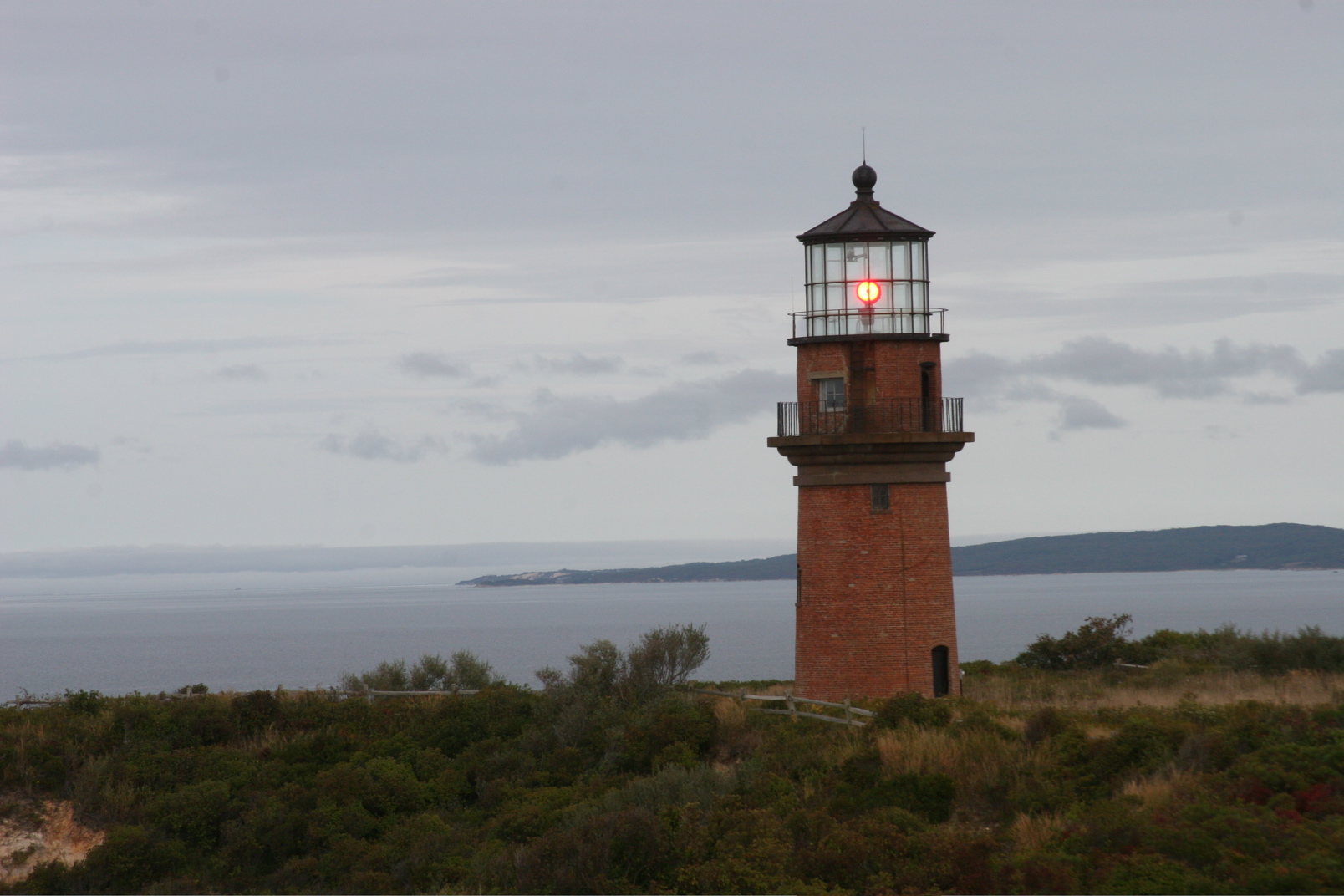
vpxiGayHead Light


The Viable Paradise workshop is over for another year.  We had writing and music and pancakes and jellyfish and a sky full of stars.  (Also, if you were me, lobster tacos at the Lookout restaurant, and I just have to say, that was one of the best things I’ve ever tasted done to a lobster.)

The photo, by the way, is of the Gay Head Lighthouse on the Cliffs of Aquinnah — one of the five lighthouses on the island.  (The others are East Chop, West Chop, Edgartown, and Cape Pogue.) It’s called “Gay Head” because the headland there is a multi-hued clay cliff.  Obligatory literature reference:  The harpooneer Tashtego, in Moby-Dick, was a Native American from Gay Head.

If you wanted to apply to VP this year and couldn’t make it, next year’s applications open on 1 January 2015.

Busy busy busy

If posting is kind of sparse for a week or so, it’ll  because Jim Macdonald and I are down on Martha’s Vineyard, where we’ll be teaching at the Viable Paradise sf/fantasy writer’s workshop.

As usual, we expect to learn as much as we teach.  There’s something about hanging out with a bunch of fellow writers and talking about technique and craft and what Edward Gorey so aptly referred to as “the unspeakable horror of the literary life” that works that way.

Gently Does It

Or, yet another cause of reader disgruntlement.

Readers – especially readers of fiction — don’t like being pushed to a particular conclusion.  They want to feel like they got there all by themselves.

Writers, on the other hand, often have specific conclusions that they want their readers to reach: this character is good and noble, and should be loved and respected; that other character is bad and wicked, and deserves whatever bad fate is coming to him or her; this course of action is socially useful and morally desirable and worthy of emulation; that other course of action is thoroughly despicable and morally bankrupt, not to mention just plain tacky.

The urge to make all of these things crystal clear to the reader is a hard one to resist.  But resist it we must, lest our stories end up sounding like the adventures of Goofus and Gallant of Highlights for Children fame.  (Surely I’m not the only person out there who as a young reader used to fantasize about staking out the insufferable Gallant over an anthill?)  I’ve talked before about the dangers of over-subtlety, but this area is one of a handful of places where the big danger lies in the other direction.  When you’re luring the reader to your desired conclusion, you need to be subtle as all heck about it – plant the necessary clues well in advance, but don’t point at them while you’re doing it, and for heaven’s sake don’t have your protagonist monologue about your conclusion afterward.

If you find it hard to tell whether or not you’re being over-obvious – and most of us do, at least some of the time – the answer is the same as it is for worrying about being over-subtle:  Find a trusted beta reader, preferably one who’s coming at the story cold, and ask them.

Then trust their judgment and fix the problem.