Boskone, Day Two

Jim Macdonald and I have a reading at 1 PM in Griffin, here in the Westin hotel, and we’re going to be reading a brand-new, just-finished short story . . . one that we’ve been mulling over for a long time, that finally came together in this past week.

If you’re here at Boskone, we’d be delighted to see you there.

Things Seen and Unseen

Let’s talk for a minute about point of view. In fact, we could talk about point of view for considerably more than a minute, because it’s a complex and many-layered thing – not to mention being, for some writers, the key to making everything else click into place. (For other writers, the key might be something else. Nothing about this job is universal, except maybe that if you don’t write you won’t ever have written.)

I’m assuming right now that if you’re reading this you’ve already absorbed Point of View 101: Third Person, First Person, and the Weird Stuff. (I’ve blogged about those already, here and here, if you want a quick refresher.)

What I’m thinking about now is a bit more subtle – it’s one of the failure modes of point of view.  Point of view is implicit in a narrative, even if it isn’t directly specified, and sometimes the narrative “sees” things which nobody is observing.  This results in clumsy writing, or in writing which, while not precisely clumsy, nevertheless has an off-center sort of wrongness to it that can have a cumulative effect on the reader’s sense of immersion in the story.

An example:

As Joe looked at the kitchen door, it was angrily thrown open.

There are a couple of things wrong with that sentence, starting with having the active observer relegated to a subordinate clause, and the important action – the throwing-open of the door – occurring as an agentless passive verb. (Who is throwing open the door? The narrative doesn’t let us see them.) Those wrong things, though, are made worse by the point-of-view failure we get in that adverb “angrily.”

Anger is an emotion, a state of mind; somebody is experiencing it as he/she/they throw open the door.  But we don’t see the door-opener, so we’re not in a position to draw inferences about their state of mind.

Fixing that sentence requires either showing us who is on the other side of that door – As Joe looked at the kitchen door, Jane angrily threw it open – or replacing “angrily” with a verb, or verb+adverb, that doesn’t have an implied state-of-mind attached – As Joe looked at the kitchen door, it was abruptly thrown open/jerked open.  (In this case, I’d probably go with the latter fix; that is, if I didn’t decide to rewrite the whole sentence from scratch, and possibly the paragraph it was part of as well.)

In a similar vein – don’t refer to a character as holding onto something with a white-knuckled grip if that character is wearing gloves.  Nobody, including the character, can see the knuckles in question.

As a general rule, when you’re writing description, it’s always good to pause every so often and query yourself:  Where is the (named or just implied) viewer standing?  Is everything you’ve just mentioned visible from that point?  If you’re doing the verbal equivalent of a tracking or panning shot, is your observation moving smoothly from point to point, or is it jumping around at random?*

Point of view may not, as I said at the beginning, be the key to everything.  Nevertheless, if you’ve got a good handle on point of view, you’ve probably got most of your other ducks lined up and quacking in formation as well.

*Yes, there may be occasions when you want a sense of jumpy and random observation.  But there, too, point of view rules:  your reader is going to draw inferences from that jumpiness about your observer’s probably-confused state of mind.
A Winter Treat

Over on Jim Macdonald’s blog, a piece of original fiction, for the entertainment of our friends and readers.

The Looming Spectre of Christmas Presents

That time of year is coming around again . . . the Northern Hemisphere Midwinter Holiday (exported to the Southern Hemisphere by transplanted Northern Hemisphereans), in which we celebrate, among numerous other things, the fact that the sun has come back for another year.  I never fully appreciated that aspect of the season when I was a young thing growing up in Florida, or even in Texas; it took moving up to live cheek-by-jowl with the 45th parallel to show me just why so many different cultures thought that the winter solstice was a thing to celebrate.  Right now, we’re in the tight and rapid end of the downward spiral, with night closing in at 4PM or even earlier, and the sense of relief when the days start getting longer again is, believe me, immediate and intense.

So we celebrate our midwinter holidays with good food and good drink and the exchange of gifts, and that brings us to one of the perennial worries of the season:  what to give to the other people in your life.

If one of the other people in your life is a writer, I can help you with that.  From now until the 26th of December, you can buy your writer friend the gift of a line-edit and critique from Dr. Doyle’s Editorial and Critique Services for the seasonal sale price of $1000.00, to be redeemed at the time of the recipient’s choice.

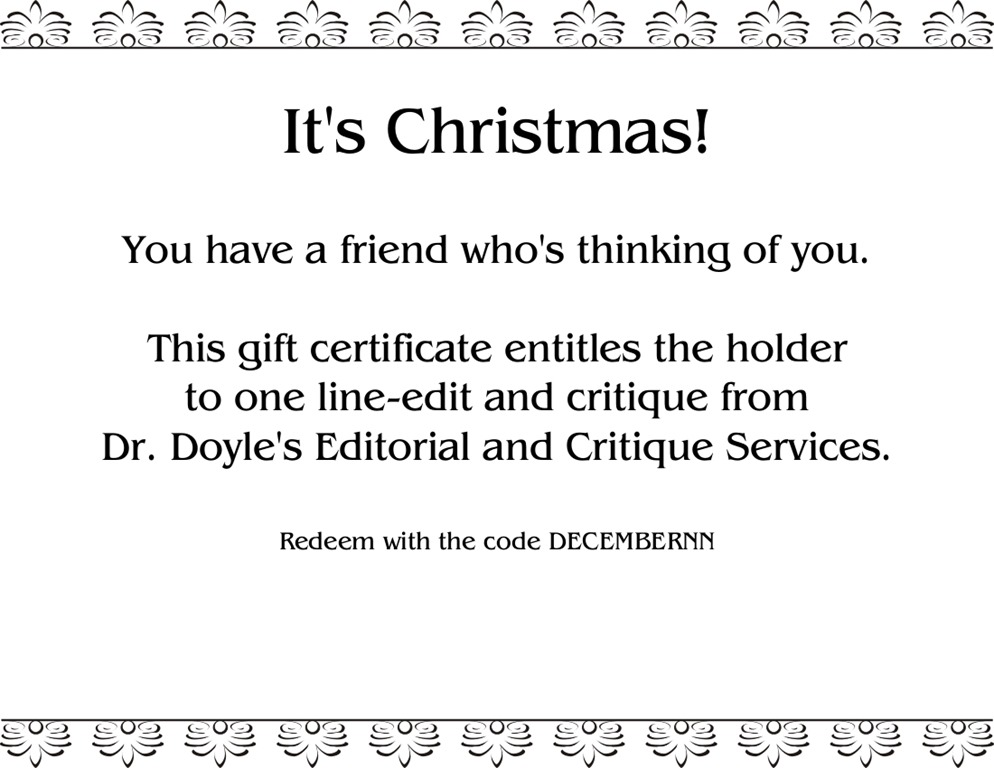
Sample December Gift Certificate

The gift purchase comes with a .pdf certificate suitable for printing out and presenting to the recipient in the wrapper or envelope of your choice.  The holiday in question can be customized for the recipient, as well.

(And if the recipient of the gift happens to be you, that’s fine, too – this has been a rough year, and we need to be kind to ourselves as well as to others.)

The Work That Binds Us Together

This is, of course, National Novel Writing Month – which really ought to be called International Novel Writing Month, as the map on its web page shows.

In a month that’s been full of bad news from all over, and much unhappiness and partisan animosity, I find looking at that map to be immensely consoling – because whatever else may be going on, there are people all over the world striving to do the same difficult but rewarding thing, and cheering each other on as they go.  The 1,994  writers hard at work in Chicago are doing their bit; so are the 8,046 in Chile and the 39 in Kenya, the 127 in Latvia and the 756 in India . . . and all the rest, all around the globe, working on their individual acts of subcreation.

(Shameless self-promotion time:  If, after you’re finished with your project, you should happen to want it gone over with an editorial/critical eye, please imagine me making a discreet gesture toward the “Editorial Services” link just beneath the header.)

Peeve of the Day

Maybe I’ve been reading too much paranormal fantasy lately, because you wouldn’t think this would be a thing I’d run into often enough to make me peevish.  Nevertheless, I do, and it does.

Listen to me, people.  Nephilim is not – I repeat, not – a singular noun.  It’s a plural noun (that –im bit is the marker), and the singular is naphil.

The same goes for seraphim and cherubim.  They’re plurals, too, and their singular forms are seraph and cherub, respectively.

If you’re going to mess around with Judaic and/or Christian esoterica, at least get the words right.  (Or as right as reasonably possible, anyhow, given that we’re talking about words that wouldn’t have been written in the Roman alphabet to start with.)

Well, the election is over

My candidate didn’t win. But as Rocky would say, “she went the distance,” and maybe that was the best we were truly likely to get at this point in time. We’ve just finished with two terms of a precedent-shattering presidency, and I’m not surprised, in retrospect, that the elastic band wasn’t up to stretching out to another one.

But I’ve voted for — pauses to count on fingers — eight presidents, now, and half of the ones I voted for won, and half of them didn’t. Which is the sort of thing that happens, with elections.

Granted, it’s still no fun to get so close you can almost taste it, and then not get it anyway.

The world goes on, however, and we as writers still have books to finish and books to edit, because people aren’t going to stop reading just because their candidate lost, or even because their candidate won.

One of the Things We Tell People in the Writers’ Workshop…

…is that if people keep telling you that there’s something wrong with your story – they’re probably right.

They may be – in fact, they quite likely are – wrong about what, exactly, is wrong with your story, but that doesn’t mean you should ignore the fact that you have a problem and the problem is real and you need to fix it.

The same thing, I would make bold to say, applies to politics.

(This is not, however, the point where I expound upon my grand theory of What Is Wrong With Our Politics and How to Fix It, because that sort of thing is not remotely within my skill set.  Your story, though, and how to improve it . . . that I can figure out, and gladly, too.)

Take Care, People.

Hurricane Matthew looks set to romp and stomp all over the state of Florida, and possibly a goodly chunk of the Atlantic coast.  Some people who might have otherwise been reading this have probably already evacuated to safer climes; for others, I direct your attention to this web page on emergency jump kits, also known in the trade as bug-out bags.  (Full disclosure:  The author of the list is also my co-author.) They’re the bag you keep packed to grab when the state police come around your neighborhood telling everyone that the dam has busted/the wildfire has jumped the firebreaks/the chemical plant has exploded and you need to get out of there now.

If you’re a writer, your jump kit might also need to contain a means of continuing your work – anything from a paper notebook and pencils to a cheap netbook and a mouse, depending upon your purse and your habits.  And it’s never a bad idea to keep a current backup of the work-in-progress on a thumb drive you can grab on the run and shove into a pocket, as well as another backup on Dropbox or Google Drive or whatever offsite server you trust with your data.

For right now – stay safe, and take lots of mental notes on the storm while you’re getting slammed by it.  You’re writers, and everything is grist for your mill.

One of the Pleasures of This Job

It’s always good when a student, or a client, does well.  Debra Jess was one of the workshoppers at Viable Paradise XVI, where I was one of the instructors, and after that, she was one of my editorial clients.  And I’m pleased as punch to say that her novel, Blood Surfer, has won the National Excellence in Romance Fiction Award (NERFA) in the Paranormal and Futuristic category.  Blood Surfer was also a finalist in the Best First Novel category.

Needless to say, I am tickled pink on her behalf.