Neophilia

Which is to say, I’ve upgraded my desktop system to Windows 10 and – so far, anyhow – nothing vital has either exploded or disappeared into the ether.

I did take good advice, though, and didn’t use the “Express” setup option, because it defaults to sharing everything with everyone everywhere, which is a stupid thing to default to, but it wouldn’t be a Windows operating system without at least one stupid default.

(And no, I don’t want to switch to the Apple side of the force.  There are people for whom the Mac/iWhatever interface is deft and intuitive, and there are people for whom it is intensely frustrating, and I’m one of the latter. )

So now I’m checking to make sure all of my previously installed apps are still working as advertised, this post being a test of Windows Live Writer.  If you’re reading these words, then presumably Live Writer tested sat.

Novella vs. Novelette

(Or, novelet.  The spelling varies.)

John Barnes explains the real difference, over here.   The explanation comes with a link to the first episode of an actual serialized novelet, also by John Barnes.  He’s a good writer and a clever guy – go read and enjoy.

An Early-June Miscellany

A trio of literary (more or less) links:

“Somewhere in the distance, a dog barked.”  If that line has an all-too-familiar ring to it, you shouldn’t be surprised.  Here’s an article from Slate on the barking-dog trope in modern fiction that will reassure you that you aren’t just hearing things that aren’t there.  If it inspires you to double-check your own stories for gratuitously vocal canines, so much the better.

Which brings us to another literary animal, in this case the dead mule, as encountered in Southern literature.  The dead mule is one of the genre-defining images, like unicorns and spaceships; much as the presence of a spaceship renders a story science fiction, the presence of a dead mule declares it to be Southern.  I don’t know what happens when you have a spaceship and a dead mule in the same story – something by Howard Waldrop, maybe.

And finally, from the editor of Clarkesworld, a list of the most common titles for short stories submitted to the magazine.

It’s Magic!

starcat030513For all you folks out there who are interested in Jim Macdonald’s other artistic vocation (the one that isn’t writing novels), tomorrow and Saturday he’s going to be doing close-up street magic in Bradford, Vermont, as part of the local downtown merchants’ Customer Appreciation Days. Look for him out in front of Star Cat Books – he’ll be the one in the hat.

Road Trip!

Magic Expo SignThis past Saturday Jim Macdonald and I went down to Boston to see Penguin Magic’s traveling expo, which was there that day.  The route and the area were familiar to us, since the Readercon site is in the same general neighborhood, but this time it wasn’t science fiction that brought us there, but Jim Macdonald’s other freelance avocation, stage magic – which isn’t as far a cry from writing sf and fantasy (or writing in general) as one might think.  Both jobs involving entertaining, and sometimes enlightening, the public by creating believable illusions . . . and both of them take a lot of hard work and practice.

Jim had a good time watching the demonstrations.  I don’t do stage magic myself (my job, in my role as Magician’s Significant Other, is to be the test audience and general critic for new tricks, old tricks, and routines under Magic Demodevelopment), but I had a good time anyway.  The event had a lot in common with various other specialized meetups I’ve attended or spectated at in my time – rock and mineral shows, mustache-growing contests, sf and fantasy conventions, and yes, writer’s workshops.  There’s a peculiar pleasure to be had in the company of a bunch of other people who all share the same obsession, and who can be counted on to understand why a person might spend all afternoon working on a new method of cutting a deck of cards, or trying out different ways of punctuating a particular sentence.

(Do I want a comma here?  Would a period and a new sentence work better?  How about two independent clauses and a semicolon?  No, that doesn’t work – the heck with it, why don’t I just cut the whole thing?  Can’t do that either, dammit; it’ll ruin the pacing, and besides, that’s an important bit of information I’m trying to slip in.  Let’s look at it with the comma again….)

Diamonds Magic StockAs is often the case at these specialized events, there’s also the pleasure of cruising the dealers’ tables and trying not to spend more money than one had absolutely budgeted for the purpose.  The setup to the left there belongs to Diamond’s Magic, which is local to the area (up here in the north country of New Hampshire, we count Boston as “local” for certain purposes. Montreal is actually closer, but we don’t need a passport to get to Boston, or at least not yet.)  We highly recommend them for all your magic-related shopping needs.

And a final note:  speaking of specialized groups and shared obsessions and the company of other people who understand why that comma is important enough to spend an afternoon fretting over it:  The application period for the Viable Paradise workshop remains open until 15 June.  If you’re planning to apply, why not get your application in now and avoid the last-minute rush?

Two Peeves and a Link

Yes – it’s grey and rainy outside today, which means that it’s peeve time here in blogland.

Peeve the first:  It isn’t “per say” (though that’s what it sounds like.)  It’s per se, because it’s Latin, meaning “by itself.”  Per is one of those useful prepositions that also shows up as a prefix, usually one that means “thoroughly” or “extremely” or “completely” – probably from one of the other meanings of per-as-a-preposition, which is “through.”  (If you think that’s a wide range of meanings to stuff into a single word, just consider for a minute some of our English prepositions, which let us say things like “He came by himself to the house by the river by car.”  Which is an awkward sentence – I’d flag it in a heartbeat if I ran across it during a revision or editing pass – but not an ungrammatical one.)

But seriously, people, if you’re going to throw in Latin phrases, at least spell them right.

Peeve the second:  Don’t say “this begs the question” when what you mean is “this raises the question.”

Nobody, but nobody, gets this one right, and it drives me batty.  “Begging the question” is the English term for one of the common logical fallacies, also known by its Latin name, petitio principii, in which the person making the argument assumes as true, and argues from, the very thing which he or she is seeking to prove.  (For a fuller explanation, with diagrams, you can look here.)

Finally, to sweeten things a bit after that outburst of peevishness, a link:

The Science Fiction and Fantasy Writers of America 50th Anniversary Cookbook, edited by Cat Rambo and Fran Wilde, is now available for pre-order.  It contains 175 recipes as well as interior illustrations, and is available in both print and e-book formats.

Sampler Platter

Some time back, I posted a tasting flight of shorter works by important authors, in the interest of giving readers a way to decide whether or not they liked a particular author enough to go on and tackle one of that author’s signature doorstop volumes.  Now, as a follow-up to that round, here’s another quartet of shorter pieces by authors of important longer works.

Henry FieldingJoseph Andrews.  Tom Jones is the doorstop (and well worth reading for its own sake); Joseph Andrews is the short one, written in response to that other blockbuster of the eighteenth century, Samuel Richardson’s Pamela.  Richardson’s novel featured a virtuous maidservant who attracts the lustful attention of her employer, Squire B, possibly the world’s most incompetent rake.  He tries everything, including abduction and a fake marriage, but never works himself up to doing the actual deed; meanwhile, Pamela steadfastly holds out for honorable matrimony or nothing, and – spoiler alert! – gets her way in the end.  Fielding, for his part, found the entire plot so silly that he responded to it first by writing Shamela, an outright parody, and then by writing Joseph Andrews, which was what we’d probably call today the genderflipped version, with the title character being the handsome young footman who resists the advances of his employer, the licentious Lady Booby, widow of the late Squire Booby (hey, no one ever said that Fielding was subtle!), and is dismissed from his position and forced to go on the road as a result.

Charles DickensA Christmas Carol.  Charles Dickens was the Stephen King of his day (or maybe Stephen King is the Charles Dickens of ours): He wrote big fat novels, and he wrote a lot of them, for a long time.  A Christmas Carol is short, but it’s got enough of the Dickens flavor that you can figure out whether you want to go for one of the doorstops – Bleak House, say, or Oliver Twist.  (You can avoid Great Expectations, if you like, and I won’t blame you a bit.  It’s the one most often inflicted upon long-suffering high school students, and has probably turned a lot of them off of Dickens for life.  Lord knows, it nearly did it for me.)  Dickens also managed, with A Christmas Carol, to come up with one of the great recyclable plots.  Hollywood, in particular, has been running riffs and changes on it for decades.

Thomas PynchonThe Crying of Lot 49.  Pynchon’s another author best known for doorstop novels like V and Gravity’s RainbowThe Crying of Lot 49 – the title refers to an item being put up (or “cried”, as the terminology has it) for auction – is short and fast-moving, an ideal way to find out of you like Pynchon enough to try the big stuff.  Highlights include a centuries-old conspiracy of uncertain intent, a (fictional) Jacobean revenge tragedy, and one of the funniest games of strip poker ever written.

Alexander SolzhenitsynOne Day in the Life of Ivan Denisovich.  Russian novels are notoriously long as it is, and Solzhenitsyn carried on with the tradition.  One Day in the Life of Ivan Denisovich is an exception, being short enough to be published in 1962 as a complete-in-this-issue novel in the Soviet literary magazine Novy Mir.  If you don’t feel up to tackling Solzhenitsyn’s mega-doorstop nonfiction work The Gulag Archipelago, One Day in the Life will give you enough about life in a Stalinist-era Soviet prison camp to be getting on with.
Three Nifty Links and a Brief Reminder

Commas are important tools in the ongoing struggle for (and sometimes between) clarity and euphony – so important that it’s easy to lose sight of the fact that, even more than most punctuation marks, commas are pretty much a local-option kind of deal.  The conventions for comma usage vary from one language to another, as I learned to my sorrow back in the days when I was learning Old English and working with a lot of OE texts that had been edited by German scholars and therefore punctuated with German punctuation.  (It’s a mark of where I learned a particular language and how I mostly used it that my rudiments of German are mostly stuff like “The following forms appear only in the dative plural,” while my fragmentary Spanish runs mostly along the lines of “Do you have Tylenol in drops for infants?”)  Comma use also varies from one century to another, and from one writer to another – some writers prefer to deploy their commas strictly according to grammatical rule, whereas others prefer to use them according to the rhythm and the phrasing of the sentence.

Under the circumstances, it’s not surprising that some people take their commas very seriously indeed.

Over in another corner of the internet (the internet has many corners), Slate columnist Derrick Johnson strikes a blow against e-mail address snobbery when he explains why he still uses his AOL e-mail account.  (Hint: because it still works just fine.)

Meanwhile, for the folklore and folk music enthusiasts among us, here’s the Vaughn Williams Memorial Library.

And finally, the reminder:  the Dr. Doyle’s Editorial Services Springtime Seasonal Special closes at midnight this coming Saturday, April 11.

Springtime Seasonal Special

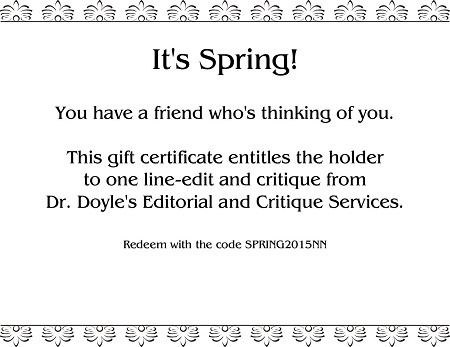
From now through the 11th of April, in honor of the arrival of new growth and brighter days, my usual rate for a full line-edit and critique drops back to $1000.  Furthermore, you can purchase a gift certificate for a friend or colleague at the seasonal price, to be redeemed by the recipient at whatever future date they find convenient.

Sample Spring Gift Certificate SmallPic

The gift certificate comes in the form of a .pdf file suitable for printing out and enclosing in an envelope, or putting into a gift-wrapped box.

(And if the person the gift is meant for happens to be you—that’s perfectly fine with me.)


For Your Amusement

A couple of language-related links of possible interest:

The first one is Strong Language: A Sweary Blog about Swearing.  I’ve said before than profanity and obscenity have a grammar of their own, and if you’re not fluent in the vulgar tongue you shouldn’t try to fake it – either do your research or leave it alone.  As for invented bad language, the kind that’s sometimes found in (usually not very good) fantasy or science fiction, let’s just say that it tends not to work very well.  If a writer doesn’t know how to swear in plain modern English, they’re not likely to be able to transpose that music to another key, either.

But if you’re minded to do the research – or if, like me, you’re a certified member of the word nut tribe – blogs like the one above are a good (and entertaining) place to start.

Another entertaining blog for the word nuts among us is Not One-Off Britishisms, a blog concentrating on bits of British slang and idiom that have migrated across the Atlantic into American English. (Not surprisingly, this blog also features profanity and obscenity from time to time, as in this post from 2012, where the blogger and commenters discuss the differing reactions on either side of the Atlantic to Loki’s insulting words to the Black Widow in The Avengers.)