
Jim Macdonald writes some more about his Independent Bookstores of New England GPS Points of Interest project, over here.
Tag: books
Independent Bookstores of New England
…considered as a set of Points of Interest for the TomTom GPS Navigator. It’s a project that my co-author (and, not so coincidentally as all that, husband) Jim Macdonald is working on in his spare time, and blogging about here.
It’s That Time of Year Again
Yep, we’re right in the middle of Banned Books Week.
This year’s Banned Books theme is Young Adult fiction. Fiction for young adults (teenagers, more or less, though actual readers of young adult books can be just about any age) draws a lot of censorship fire.
The reasons aren’t hard to guess. Teenagers make a lot of people nervous. They’re too big to be physically coerced with any guarantee of success, they’re heading toward independence of thought and action with a singleness of purpose that’s bound to frighten anybody with a vested interest in keeping them under control, and they’re exposed to all sorts of strange and threatening new ideas on a daily basis. The gatekeepers that could be relied on* to keep unwelcome ideas from getting too close to younger children – parents with the power of the purse, teachers with control over the reading list and the classroom bookshelves, librarians with the whole children’s collection in their hands – hold far less sway over teenagers with money of their own to spend and the ability to range freely in both the physical and on-line worlds.
Hence, the often frantic efforts to keep as tight a grip as possible on those sources of teenage reading material that are susceptible to control – and we all know what Princess Leia said about that.
*At least in theory – librarians these days are often dangerous radicals themselves.
Link of the Day
Now out in e-text in all the usual formats – Debra Jess’s science-fiction romance novel, Bloodsurfer. (The link will take you to her blog post with links to all the usual suspects.)
I’m claiming just a wee bit of bragging rights on this one, because Debra Jess is a Viable Paradise alumna, and also one of my editorial clients.
So, go – buy, read, have fun!
Link of the Day
Star Cat Books in Bradford, VT, must pay its back rent (the long cold winter was hard on business.) Small independent bookstores are a good thing. Help keep this one going.
A Peeve and a Signal Boost
First, the signal boost: Fran Wilde’s novel Updraft comes out today. Smashing science fiction from a Viable Paradise alumna, available in hardcover and ebook formats from the usual suspects.
And now the peeve, because while it’s the first of September summer isn’t quite ready to let go of us just yet, and hot weather makes me feel peevish:
For heaven’s sake, people – copyeditors of the world, I’m looking at you – learn the difference between auger and augur. Writers have at least some excuse, since the gift of good writing and the gift of good spelling are very much not the same thing, but it’s a copyeditor’s job to be aware of these differences and keep good writers from looking like bad spellers in front of the reading public. For that reason, it annoys me when I spot mistakes like this in published work.
Okay. Deep breath.
An auger, with an e, is a drill, specifically a tool with a helical bit for boring holes in wood or dirt.
As part of his cunning plan to do away with his fishing partner, Joe used an auger to drill a hole in the bottom of the rowboat they used on alternate days.
An augur, with a u, is an ancient Roman prophet or soothsayer, specifically one who was trained in reading the future from omens such as the flight of birds (and not to be confused with a haruspex, who did the same thing by studying the innards of sacrificial animals.) The predictions thus obtained are known as auguries, and the verb to augur still means “to portend a good or bad outcome.”
Joe’s fishing partner (who commuted on alternate days from ancient Rome by way of temporal translocation) consulted an augur about the day’s fishing prospects. The augur, observing a flight of geese in the left-hand rear quadrant of the sky, said that the signs did not augur well for going on the water that morning. When the rowboat sank at the pier later that day with no-one on board, Joe’s partner’s confidence in the auguries was confirmed.
So. Two different things, two different spellings.
Today’s Mail
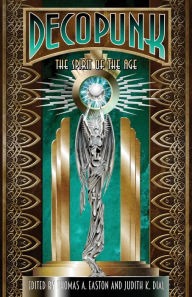 In addition to the usual unsolicited credit card offers at rates that make “usurious” sound like a good deal, the postalperson today brought us our authors’ copies of the anthology Decopunk: The Spirit of the Age, which contains our short story, “Silver Passing in Sunlight.”
I really like that cover, by the way . . . if they made a poster out of it, I’d put it on my wall.
Questions That Nobody Asked Me, Take One
Q. I really loved To Kill a Mockingbird, and Atticus Finch was my hero. Do I have to change all that in view of the publication of Go Set a Watchman?
A. Only if you want to.
If you don’t want to, there are several good reasons why you shouldn’t have to.
Reason One: Go Set a Watchman is not a sequel to To Kill a Mockingbird just because it takes place in a later decade. It was written before To Kill a Mockingbird, but wasn’t published until just now. If either version of Atticus Finch is to be regarded as the “real” one, the title should go to To Kill a Mockingbird Atticus (“Atticus Prime”, as the Star Trek fans would put it) rather than Go Set a Watchman Atticus (or “Reboot!Atticus”, to continue the Trek analogy), by right of prior publication.
Reason Two: Given that To Kill a Mockingbird and Go Set a Watchman, by virtue of their peculiar history, do not actually stand in a text-and-sequel, or even a text-and-prequel, relationship, but are separate books, then Atticus Prime and Reboot!Atticus can safely be regarded as distinct and separate characters who just happen to share a name and place of residence. (Again, science fiction readers already have a model to hand for dealing with things like this: two separate universes, parallel but different in some key respects. Not quite Spock-with-a-Beard territory, but similar.)
Reason Three: Go Set a Watchman, until recently, was never meant to be published at all. It was what is sometimes referred to as a “trunk novel” — that is, an early work that the writer, usually for good and sufficient reasons, has put away in a trunk (or a desk drawer, or a computer file in an increasingly-obsolete format), never to see the light of day.
Sometimes, however, a trunk novel does eventually get published. A writer may achieve sufficient popularity that it becomes a good bet that readers will buy even his or her old grocery lists, at which point somebody — maybe the author, but often the author’s literary heirs or executors — will decide to haul that manuscript out of obscurity and turn it loose on an unsuspecting public.
The reason for this, not surprisingly, is usually money.* Either the author needs it, or the heirs-or-executors want it, or both. If the author is dead, and the heirs-or-executors are nowhere in evidence, then the coin involved is likely to be scholarly reputation.
So, no. You don’t have to throw out your copy of To Kill a Mockingbird and consign Atticus Finch to the dustheap of abandoned role models unless you, personally, want to do that thing. Which is your decision to make, not mine, and if I have any position at all on this, it’s that every person has a right to their own reaction to a work of art.
*Because writers have this annoying tendency to starve if they can’t buy groceries. Go figure.
Of Books and Stew
A brief thought on the science fiction and fantasy community’s ongoing Hugo controversy (which is too depressing to have more than a brief thought about, especially before noon; for more links than you can probably stand to shake a stick at, go here):
If books I especially like are considered as analogous to chunks of beef, while books I don’t care for that much are considered as analogous to a collection of assorted vegetables, then “this beef stew has more vegetables in it than I prefer” is a not unreasonable statement. Likewise, the assertion “this isn’t a beef stew with vegetables anymore, it’s a vegetable stew with beef” – while almost certain to be productive of considerable argument about the precise definitions of “stew” and “with” (and probably the definitions of “vegetables” and “beef” as well, once people really get going) – isn’t especially unreasonable, either.
What is unreasonable, though, is if I go on from there to shouting out loud in the public street that my local diner HAS BEEN TAKEN OVER BY A VEGETARIAN CONSPIRACY!!!
And if at any point I start threatening to burn down the whole diner if the proper proportion of beef (good) to vegetables (bad) is not restored, then I have become a danger to the community and ought to be gently removed from it.
Nifty Link of the Day
Sherwood Smith has a blog post up at the Book View Café, talking about women writing space opera (since there are still a few readers out there who, despite all the evidence, seem to believe that the possession of girlybits negates the ability to write about epic space battles.)
Full disclosure time here: I would have liked this post even if it didn’t say good things about one of mine-and-my-husband/coauthor’s own space opera novels (and its sequels), The Price of the Stars.
 Dr. Doyle's Blog