Chewed and Digested

Books that influenced my life in one way or another (in no particular order):

The Lion, the Witch, and the Wardrobe
I encountered this book in fifth grade – pulled it off the shelf in the school library because the title intrigued me – and ran head on into symbolism and allegory for the very first time at the Stone Table. I’m immensely grateful, in retrospect, that I didn’t have anybody around to explain things to me, because noticing and figuring out all the connections made the top of my head come off, in a good way: I’d never had any idea, before then, that you could do that sort of thing with a story. For a long time afterward, it felt like this nifty thing about the book that nobody knew but me.

Little Women
Because, of course, I wanted to grow up and be a writer, like Jo March. (Be careful what you wish for. You may get it.)

The Iliad and The Three Musketeers
I think of these as a pair, because I read them both in the sixth grade, in unabridged translations, and  between them they shaped my expectations of great literature . . . I think I was lost to the modern  mainstream at that point. After that, I wanted grand themes, and larger-than-life characters, and panache. I  loved the Odyssey, too, but it didn’t move into my brain and take over large chunks of its processing power for several days after the first reading, the way the Iliad did. Although Odysseus was, in some ways, one of my  first literary crushes – I was then as I am now, a sucker for brainy heroes.

My Life and Hard Times
James Thurber became one of my style gods early on. I think that by the time I graduated from high school I’d already read through most of his available works at least once, and by the time I graduated from college I had whole swathes of it memorized.

Ordeal in Otherwhere
The first science fiction novel I read with the conscious awareness that it was a science fiction novel. After that, I read pretty much all of Andre Norton that I could track down.

The Miracle of Language
This was a paperback edition of a popular book on historical and structural linguistics, and how it came to be in stock on the wire rack in the local newsstand that was all my small Texas hometown had for a bookstore, I’ll never know. But I found it, one summer while I was in high school, and it was my first  introduction to linguistics as a scholarly discipline. If one of the key experiences of adolescence is that moment when you realize that your elders have been lying to you all along about something – well, this book did it for me. I read it, and I realized (with the traditional unforgiving clarity) that all the stuff that they’d been telling me for years in English class about the way the language worked was Wrong, and that yes (cue the light bulbs and fireworks!), some of the insights I’d had all along were Right. I’ve been a language nut ever since.

Dragons, Elves, and Heroes
Lin Carter’s anthology for Ballantine Books of excerpts from the medieval source and analogue material for Tolkien’s works. I read the anthology because I’d read LOTR, but after I read the anthology I became interested in the source materials for their own sake. It was, more even than Tolkien’s work itself, the thing that kicked me in the direction of becoming a medievalist.

In Search of Wonder
Damon Knight’s collection of critical essays about science fiction. I found it in the university library my freshman year, and read it repeatedly. It did more to inform my science fictional literary aesthetic than almost anything else.

A Wizard of Earthsea
I read this one during the summer between high school and college, and (like The Lion, the Witch, and the Wardrobe, earlier) it made the top of my head come off. None of the others in the sequence ever quite measured up to it, and by the time LeGuin got around to Tehanu I found myself wishing she’d left well enough alone several books back . . . but that first book was a wonder.

Guest Post: Learning Curves

[Today’s post is a guest post, courtesy of Alice Loweecey, because I’m on the road this weekend.]

Learning Curves: They’re Not for the Timid

I’m a mystery writer. Well, not initially. From a wee age I wrote horror. Love the stuff. Started watching Hammer films with my dad when I was five. (Christopher Lee as Dracula can’t be beat.) Love dystopian post-nuke books too. So when I decided to pursue the dream, my first completed book was a post-apocalyptic horror.

That was a learning curve. I rewrote it four times.

Then I wrote a mystery. Which is nothing like writing horror. Learning curve #2. I discovered the joy that is outlining. I knew that I had to plant clues and remember where and when I planted them.

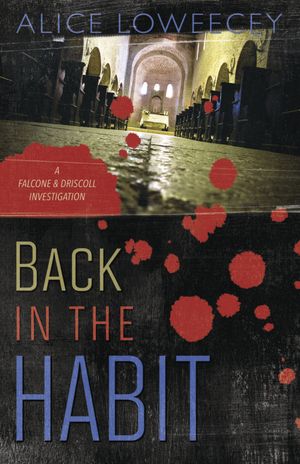
The good thing about the frequent and steep learning curves is that they taught me how to write tight, clean prose with 3-D characters. Those skills helped me get an agent and a three-book deal with the ex-nun Private Eye mystery. You can see their covers here: Force of Habit, Back in the Habit (both in stores now), and Veiled Threat (hits stores 2/8/13).

More characters moved into my head. YA characters.

I’m a mystery writer, I told them. They wouldn’t shut up. I’m a horror writer, I told them. Adult horror. Adult mystery. They ignored me and kept on yammering. I had to shut them up.

Learning curve #3: YA.

And I thought horror-to-mystery was steep and rocky. Hahahahaha!

I broke it down into manageable steps. First: Head to the library and read two dozen current YA books. Because these characters told me they lived in a post-cataclysmic dystopian Buffalo and Niagara Falls, I chose dystopian, paranormal, and UF books.

For one month, I read YA, taking notes on the differences between YA and adult. This placated the characters in my head.

The biggest differences were voice and speed. I’d forgotten that everything is life or death during the teenage years. How important what other people think about you is. How much you obsess over that and clothes and boys and parents and… everything.

The pace of YA is often much faster than adult fic. I saw less introspection and more action. Fewer gab sessions and more Run! Attack! Regroup! Sneak a kiss! moments. Not to say that the latter aren’t to be found in adult fic—not at all. But overall more things happen, and happen faster, in YA.

After I immersed myself in current YA, I returned to my never-fail creation tool: Character Charts. I use the ones from Randy Ingermanson’s Snowflake Method. I have the full version, which was part of my very first large writer’s conference. (Did I say learning curve? That was an eye-opening weekend.)

I start a new book with the MC, his/her love interest/partner, the antagonist, and a short pitch line. When I open the character chart and start with the basics—name, age, height, weight, description—the characters really begin talking to me. They look at the 30-plus items in the chart and tell me what they read and listen to, what they wear and where they work. What their dreams and fear are. This is how I learn about them and the plot—because what they tell me often shows me important plot points.

This was the familiar part of writing YA, because I do the exact same thing for an adult book. So was the next part—writing the outline.

Outlines aren’t for everyone. I pantsed my first book. But once I outlined a mystery, I was hooked. Some writers say that outlining the book from start to finish takes all the excitement out of it. For me, it’s like a basic knitting pattern. I know the measurements, but what I do with yarn and pattern stitches is new every time.

I kept the outline (an Excel spreadsheet) open in one window and the character charts open in another. New characters jumped into the outline as I wrote it, so I created a character chart for them. Items to research got their own column in the spreadsheet. Whenever I got stuck in the plot process, I switched to research.

Learning curve #4: What’s okay in adult fic isn’t necessarily okay in YA.

Yep, that means explicitness. When the book was ready to send to beta readers, they all advised me to tone it down. That meant the language and a few bits of nookie and innuendo that wouldn’t be a problem in an adult book. My agent had me tone it down even further—twice.

While I was still mulling this book over in my head, I talked to some writer friends who wrote extensively in YA. Their unanimous piece of advice was: Get deep into the MC’s head. Which led to…

Learning curve #5: First person.

All my other books (4 at the time of writing this YA) were in close third. I like close third. It’s my preferred reading and writing choice This YA started out in close third, and it was… wrong. The MC wasn’t alive. The story was flat. The dialogue was stilted. Everything stopped with a whump. I realized why a lot of YA was written in first. It lets the reader dive into the MC’s head and experience everything just as he or she is. I realized it worked especially well with YA’s faster pace.

So I looked first person in the eye and said: I will conquer you. I went back to the library and found half a dozen current YAs in first person. I put the WIP away and read all the books. Then I started over.

My MC opened her mouth and her story came alive. Her world, her family, her fears, her dreams. Four months later, I had a finished book. A month after that, I had beta comments and a revised draft to send to my agent.

That book is on sub to editors now—the final step to achieving the Holy Grail: A book deal

The learning curve—curves, plural—were worth it, no question. I’m a more skillful writer because of it. When (never ‘if’!) the YA sells, I have ideas for at least two sequels. Right now I’m writing a paranormal romance with a touch of steampunk. It’s not YA. But my next book could be. It all depends on who invades my head. And I’ll be able to write it because I didn’t back down from the learning curves.

Alice Loweecey is a former nun who went from the convent to playing prostitutes on stage to accepting her husband’s marriage proposal on the second date. Her teenage sons clamor for dramatic cameos in future books, but she’s thinking they’ll make good Redshirts. She is a member of Mystery Writers of America and Sisters in Crime. Visit her website at www.aliceloweecey.com and check out her books on her author pages at Amazon.com and at Barnes and Noble.

Reading like a Writer

If you want to be a writer, they say, you first have to be a reader.

And it’s true.  We learn our craft by emulation, observing those who came before us and patterning our works on theirs, taking what they’ve left us for our foundations and building new structures out of our own material.  But before we start reading as writers, with one eye always turned toward observing how the thing is done, we read purely as an audience, as most people who are not themselves writers read — and we lose this, I think, once we learn to read as writers.

Mark Twain knew the phenomenon, though he first encountered it in his days as an apprentice riverboat pilot.  In Life on the Mississippi, he writes of observing a beautiful sunset on the river, and then of watching the same sunset as a pilot would see it:

I stood like one bewitched. I drank it in, in a speechless rapture. The world was new to me, and I had never seen anything like this at home. But as I have said, a day came when I began to cease from noting the glories and the charms which the moon and the sun and the twilight wrought upon the river’s face; another day came when I ceased altogether to note them. Then, if that sunset scene had been repeated, I should have looked upon it without rapture, and should have commented upon it, inwardly, after this fashion: This sun means that we are going to have wind to-morrow; that floating log means that the river is rising, small thanks to it; that slanting mark on the water refers to a bluff reef which is going to kill somebody’s steamboat one of these nights, if it keeps on stretching out like that; those tumbling ‘boils’ show a dissolving bar and a changing channel there; the lines and circles in the slick water over yonder are a warning that that troublesome place is shoaling up dangerously; that silver streak in the shadow of the forest is the ‘break’ from a new snag, and he has located himself in the very best place he could have found to fish for steamboats; that tall dead tree, with a single living branch, is not going to last long, and then how is a body ever going to get through this blind place at night without the friendly old landmark.

No, the romance and the beauty were all gone from the river. All the value any feature of it had for me now was the amount of usefulness it could furnish toward compassing the safe piloting of a steamboat.

What he had gained in knowledge, he had lost in the ability to see the river as a naive observer.  Writers suffer a similar loss; it makes us tend to admire technical virtuosity, or the ability to carry off what we know is a difficult effect, or a piece of well-managed complexity, and keeps us from experiencing the text in the same way as a non-writing reader would experience it.

Which wouldn’t be a problem, except for the fact that those non-writing readers, in most cases, are the audience that we’re writing for.   So we need to keep firm control of the temptation to play complicated games with our text for the sake of amusing and impressing our fellow writers; or if we must play games, we should remember to give the rest of our audience value for money as well.

One Thing After Another

When you live three hours by road from the nearest city of any size (and by “of any size” I mean “is able to support at least two separate movie theatres and a shopping mall”), you end up listening to a lot of audiobooks.  You also end up realizing that not all books make good road listening.  You don’t want the sort of book you have to devote a lot of mental processing power to decoding in some fashion — at any rate, you don’t if you’re me, and spend a lot of your driving-and-listening time in the sort of environment where it’s necessary to devote at least a portion of your brain to keeping an eye out for moose in the road.

(Important safety tip, here:  Brake for moose.  As far as the moose is concerned, it doesn’t stop for other things, other things stop for it.  Unless you’re an entire pack of wolves, it doesn’t consider you a threat worth bothering with.)

What you want, for driving a long way at night on a moosey road, is a book that isn’t so complex you’ll lose track of everything else you’re doing, but with enough stuff going on that you’ll stay alert and not succumb to highway hypnosis.  Of late, our household has found that the novels of Edgar Rice Burroughs (available for free download from Librivox) are just the ticket.  Granted, Burroughs is not the most elegant of prose stylists, nor the most original of thinkers, and he can be counted on to exhibit just about every -ism to which a white male Anglo-Saxon Protestant writer from the first decades of the twentieth century might be susceptible . . . but when it comes down to sheer one-damned-thing-after-another plot construction, the man is hard to beat.

Weather for Working

The writing life has its ups and downs, but on days like today it at least has the advantage of taking place largely indoors.  Because if I had to do my work outside on a day like today, I do not think I would get any work done at all.

Spring is a good time to write.  So is autumn.  Winter is great, so long as you can afford to keep the heat on.   But summer is not a good time for any sort of strenuous endeavor, even of the intellectual kind.

Summer heat waves don’t summon up the good times in fiction, either.  They bring us Southern gothic novels featuring humidity and honeysuckle and family secrets (a dead mule may also be involved at some point); and if the supply of Southern gothic fails, the dog days also have a stock of noir-tinged detective novels full of adultery, blackmail, and conspiracy to commit murder.

Only in children’s and young adult fiction, really, is summertime a pleasant source of adventure and romance.

Canon Fodder

Literary canon formation is a zero-sum game.  I can think of several reasons for this, including the tendency of the literary establishment to turn absolutely everything into an exercise in hierarchical ranking — there are people out there in the world who can’t even look at a sack of potatoes without wanting to sort them in order from The Very Best Most Nearly Platonic Potato down to The Potato Which Barely Made It into the Sack in the First Place.

And then you have the Two-Semester Literature Survey Course — taught, usually, from the Fat Two-Volume Anthology. Combine compulsive ranking of everything with a limited amount of anthology shelf space, and literary scholarship starts to look like an episode of Survivor: Bibliography.  Tenured professors and rising scholars engage in war to the knife to decide whose chosen texts are more important, more artistic, more nourishing to the mind and spirit . . . and recognizing something as “good” isn’t going to be enough.  It can’t just be good.  It needs to be better.  It has to be best.

If this is beginning to sound a bit like those other arguments . . . the ones over whether the Enterprise-D could take out the Death Star, or about who’s the bigger hero, Batman or Superman . . . well, let’s just say that the people involved in all of these arguments take them very very seriously.  The problem with the literary-canon-formation argument is that it slops over onto the heads of everybody else in the reading world, and tends to alienate a whole lot of people once they notice that it’s often their preferred reading material that’s getting dissed.  Their reading material doesn’t get a ticket onto the canon island at all, and when they ask why, the answer that comes back sounds to them an awful lot like “because all that fun prole stuff you people like isn’t high-level enough to be art.”

I don’t want to blame the literary canoneers too much, though.  It’s amazingly difficult to talk about the whole idea of voluntary avocational reading without the use of language which, deliberately or not, imposes rank and hierarchy upon it. We speak of “higher levels” of difficulty, and “greater” challenges; and — in our still-puritanical society — even words like “pleasure” and “relaxation” have a faint negative cast to them, especially when set beside words like “instruction” or “insight” or “self-improvement.”

I’m willing to accept that somebody else may find enjoyable something that I do not. After all, most of the people who tried to convince me, during my school days, that organized team sports were fun, certainly appeared themselves to enjoy them. But I’m no more fond than the next person of being told, or even feeling like I’m being told, that my enjoyment of those things that I do like is in some fashion inferior to the enjoyment experienced by other people who like something else.

My theory (I believe I’ve articulated it at the Viable Paradise workshop once or twice) is that what most of us are looking for in our reading is the perfect birthday present effect — the perfect birthday present being the one where you’re completely surprised by exactly what you’ve always wanted.

And nobody likes being told that their perfect birthday present is actually a cheap piece of Walmart trash.

Cover Me

Publishers over the years have devoted a lot of time and thought into making the typical mass-market paperback cover, in particular, an effective point-of-sale advertisement for the book within.

Continue reading “Cover Me”

Fake Nose and Eyeglasses

Writers talk about writing a lot. Sometimes, their sharpest observations are made in places where you (and possibly they) think they’re talking about something else. Continue reading “Fake Nose and Eyeglasses”