A Trio of Assorted Links

A guide to semicolon usage, with illustrations.  Some people find semicolons intimidating; this is the post for them.  Other people love semicolons not necessarily wisely, but too well; I’m not sure if there is any help for us.

An article on Slate, ranting about the overuse of unnecessary synonyms for “said.”  I’ll be over here on the sidelines, waving my pompoms in enthusiastic agreement.  Ninety-nine times out of a hundred, “said” is all you need, assuming you need a dialogue attribution tag at all.

And Great Britain’s Arts and Humanities Research Council has released a digitized collection of Jane Austen’s manuscripts, including drafts and juvenilia.  I love living in the internet age, I really do . . . time was, to see something like this, you’d have had to make a trip (in the case of Jane Austen’s MSS, a number of different trips) to visit the material in person.

Time’s A-Wastin’

vpxiGayHead LightApplications for  the Viable Paradise Writers’ Workshop are still open for this year, but the door shuts on June 15, so if you’re interested, better get your submission ready soon.  Viable Paradise is an intensive one-week residential workshop for science fiction and fantasy writers, held annually in the autumn on the New England island of Martha’s Vineyard.

Full disclosure:  Jim Macdonald and I are instructors at the workshop.  So are several other really fine people.  And instead of getting us one after the other like a parade, you (if you’re a student) get all of us at once, interacting not only with your fellow students but with each other – “This story is the wrong length; it needs to be shorter!” one instructor will say.  ‘’This story is the wrong length; it needs to be the first chapter of a novel!” another will respond.  (From which the takeaway lesson is usually that your story is indeed the wrong length, but it’s up to you to decide which way to fix it.  Also, that short story writers tend to think that problem stories need to be shorter, while novelists . . . you get the idea.)

What This Election Year Needs is a Good Anthology

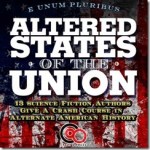
Altered-States-promo-art-640_thumb.jpgAnd hoo-boy, have we got one for you: Altered States of the Union, edited by Glenn Hauman for Crazy 8 Press.  (Full disclosure: Jim Macdonald and I have a story in it.)

Altered States is a collection of original alternate-history stories in which the states of the USA are  . . . not as we know them.  It’s being crowdfunded through Indiegogo, and you can reach its web page here.

Rewards being offered for supporters range from a copy of the e-book version of the anthology (at the $5 level, or $3 for the first 20 early-bird pledges) to tuckerization* in one of the stories (at the $200 level; six chances are being offered.)  The official publication date is scheduled for the Shore Leave science fiction convention being held July 15-17, 2016, in Hunt Valley, Maryland.

So here’s your chance to be a patron of the arts and enable the publication of some good new stories.  (Lorenzo di Medici would totally have kicked in a florin or two.  You know he would have.)

*For those unfamiliar with the lingo of the sf tribe, “tuckerization” is the naming of a character in a story after a friend or fellow-fan.  The name derives from the early science fiction writer Wilson Tucker, who made a practice of giving his minor characters names in this fashion.  These days, opportunities to be tuckerized are often offered by writers for fundraising or charitable purposes.

One of the Good Things About Teaching

— and about editing, for that matter is the the opportunity to point with pride at a student’s (or client’s) success.

On this occasion, I can bask in the reflected glow from Viable Paradise alumna Fran Wilde’s winning of the Andre Norton Award for YA science fiction at the Nebula Awards just past for her novel Updraft, which also won the Baltimore Science Fiction Society’s Compton Crook Award for best first novel.

And as if that weren’t enough illumination, there’s a further glow coming by way of Debra Jess, another VP alumna and a Dr. Doyle’s Editorial client, for her novel Bloodsurfer, which is a finalist in two categories (best first novel and best paranormal) of the Greater Detroit Romance Writers of America Booksellers’ Best Award. The winners will be announced at this summer’s RWA convention.

Needless to say, I’m tickled pink for them both.

April Showers Seasonal Special Time

Because it is now, at least in theory, spring (the thermometer got down to 10°F last night, so what it is in practice is something else again), it’s time once more for a Seasonal Special Offer.

Sample Spring Gift Certificate2016Small

From now through the 15th of April, in hope of warmer and brighter days to come, my usual rate for a full line-edit and critique for a standard-weight novel drops back to $1000.

Furthermore, you can purchase a gift certificate for a friend or colleague at the seasonal price, to be redeemed by the recipient at whatever future date they find convenient.  Needless to say – but I’ll say it anyway – you can also take advantage of this seasonal offer to pre-purchase a line-edit and critique for yourself on the same terms.

Also, for your amusement:  How to make a gingerbread TARDIS.

Peeve of the (New Year’s) Day

Regarding that common colloquial affirmative:

People, it’s spelled either “okay” or “OK.”  It is not spelled “ok” in  lower-case.  “O.K.” with periods in it is defensible, but only just.

My own preference, when I get a chance to enforce it, is for “okay.”  This is in part aesthetic, in that I just plain think it looks better than “OK”, and in part a reflection of my considered belief that the etymologies deriving the term either from the humorously-misspelled “Oll Korrect” or the tip-of-the-hat-to-Martin-Van-Buren “Old Kinderhook” are, to put it mildly, full of it.  I go with the theory that the origin of the term is in a borrowing from either Choctaw or one of the West African languages, or possibly from both.  (And I certainly would never put forward the conjecture that resistance to that etymology comes from an unwillingness on the part of some scholars, back in the day, to admit that American English might have borrowed such a useful word from anything other than a lily-white source.)

As for when writers of fiction should use “okay” and when they should avoid it (personal opinion alert here):  Writers of contemporary mainstream and literary fiction have free rein to do as they choose.  Ditto for contemporary mystery and romance.  It’s the writers of historical fiction, science fiction, and fantasy who have the tough decisions to make.

Historical fiction – still, of course, strictly in my opinion – should avoid “okay’’ except for eras when it was in use.  To do otherwise risks breaking the illusion being created for the reader by the introduction of a glaringly contemporary item into a careful arrangement of past details.  The same principle holds for created-world fantasy written in the high style, or created-world fantasy that strives for a non-modern sense of time and place.  Created-world fantasy written in a vernacular style, or urban fantasy, or fantasy set in the contemporary era or in some time and place closely resembling it, can use “okay” at will.  Science fiction is also an “okay”-okay zone.

Edge cases, as always, remain edgy.  Consult with your artistic conscience and use your best judgment and hope for good luck.

Because in the long run, it’s always the writer’s book, and you’re entitled to do whatever you think you can get away with.

Okay?

Okay.
I Think I’ve Finally Figured it Out

I’ve always been a sucker for a well-done redemption arc in my fictions of choice, in both written and visual media. And I’ve always been puzzled by the vocal commentary that always arises on such occasions, to the effect that so-and-so doesn’t deserve redemption. Because – in my cultural tradition, at least – the whole point of redemption is that it isn’t something you get because you deserve it, it’s something you get because you’ve done something bad enough that you need it.

But if the naysayers are operating out of a definition of “redemption” that has no theological or philosophical dimension to it, but is instead merely a shorter way of saying “rehabilitation in the court of public opinion” . . . well, I may still think that a lot of them are full of it, but at least I can understand how they got there.

(Also – if you’re going to write a redemption arc, don’t cheat by making your character-to-be-redeemed guilty of something that they/their culture think is a Big Wrong Thing but that we, enlightened souls that we are, consider to be Not Really That Big a Deal.  They need to be really and truthfully guilty of something really and truthfully bad, or there’s no point to the exercise.)

Thought for the Day

A piece of fiction is a carefully-crafted series of lies told to the reader, which the reader agrees to believe for the duration of the story.  Anything that threatens the fragile nature of this agreement is bad.

This is, for example, why it’s necessary to do your research – if you get something wrong that your reader is in a position to notice, the reader’s ability and desire to continue playing along with you is going to be compromised. The same goes for poorly-motivated characters and plotting by incredible coincidence.

It’s just one of the many oddities of the writer’s craft.  We are, or at any rate ought to be, scrupulously honest and careful about the small stuff, all in service of a bald-faced falsehood:

Listen. I’m about to tell you a true story….

Down to the Wire

A timely reminder:  applications for this year’s Viable Paradise workshop close at midnight on the 15th of June – that is to say, this coming Monday.

If you’re on the fence about applying, time to hop off and get your application in the mail!

A Timely Reminder

Applications are still open for the Viable Paradise Writer’s Workshop on Martha’s Vineyard, running this year from October 18-23.  If you’re definitely planning to apply, help spread out the admin workload by going ahead and doing it now; if you’re still on the fence about it, let me urge you to give the workshop a try.

It occurs to me – as it does every year about this time – that not everybody outside of New England can be counted on to know that Martha’s Vineyard is an island off Cape Cod, accessible by Cape Air and the Martha’s Vineyard  ferry.  (Or, I suppose, by your private plane or personal yacht, should you have one.)  As such, it has excellent seafood, five picturesque lighthouses, and glowing jellyfish.

Applications close on the 15th of June; get yours in now and avoid the rush!