
If you’re a Scrivener user, and like to play around with the Name Generator tool, here’s a web page with a bunch of importable name files compiled by the owner from various sources.
Category: Research
A Useful Tool
Someday, you’re going to be writing a story where you really, honestly need to know the time of sunrise, sunset, or twilight on a particular day in a particular place.
Maybe you’re writing historical fiction, and need to know whether your characters are going to have enough light left in the day to do whatever it is you want them to do.
Maybe you’re writing fantasy or horror, and need to know when your creepy-crawlies can emerge from their coffins or lairs or shadowy pits and go forth to rule the night.
If so, then the U.S. Naval Observatory has a web page for you.
The web page speaks of “civil twilight,” defined as:
the limit at which twilight illumination is sufficient, under good weather conditions, for terrestrial objects to be clearly distinguished; at the beginning of morning civil twilight, or end of evening civil twilight, the horizon is clearly defined and the brightest stars are visible under good atmospheric conditions in the absence of moonlight or other illumination. In the morning before the beginning of civil twilight and in the evening after the end of civil twilight, artificial illumination is normally required to carry on ordinary outdoor activities.
This is the kind of twilight you’ll probably be concerned with. There are two other, more specialized, twilights – nautical twilight is when “the illumination level is such that the horizon is still visible even on a Moonless night, allowing mariners to take reliable star sights for navigational purposes” and astronomical twilight is when “the center of the Sun is geometrically 18 degrees below the horizon.” But unless your protagonist is a navigator or an astronomer – in which case you’ve got more research ahead of you than a quick web page check is going to handle — you probably won’t need either of those.
In the meantime, think good thoughts about the U. S. Navy, figuring these things out so writers don’t have to.
A Couple of Good Things
The first is a link to an IndieGoGo fundraiser for Hadley Rille Books, a small press specializing in speculative fiction and prioritizing “new voices from women and other historically marginalized points of view” since 2005. They’re raising funds for the expansion necessary to stay competitive in today’s commercial environment.
Rewards at various levels include e-books, hardcover novels, and e-book bundles, manuscript critiques and full-manuscripts edits, tuckerization† in a novel by a Hadley Rille author, and more.
The second is a link to the on-line archives of Florilegium, the journal of the Canadian Society of Medievalists/Société canadienne des médiévistes, who now have the complete run of their back issues, dating from 1979 onwards, available in digital form. Writers of fantasy and historical fiction set in actual or pseudo-medieval societies would probably have a good time prowling through the articles available.
As usual, the internet is full of wondrous things. Go forth and enjoy.
†A term from the sf/fantasy community, referring to the inclusion of a person, or the use of the person’s name, in a novel or story, usually as a complimentary in-joke. Opportunities for tuckerization are often offered as prizes in benefit auctions and the like. The term derives from the name of sf writer Wilson Tucker, who pioneered the practice.
Looky Here!
It’s National Library Week! And the Oxford University Press is making its on-line resources free this week in honor of the occasion!
(Username and password: libraryweek. Access in the US and Canada only.)
Nifty Thing of the Day
Thanks to the good offices of Trinity College, Dublin, the Book of Kells is now available on-line in high-quality digitized glory.
It’s also (and this is the part that fills me with pleased amazement) available as an iPad app.
Research: Old Sources and Bad Sources
To begin with: they are not the same thing.
It’s true that when you’re doing research for something (and it’s hard to be a writer and not need to research things from time to time, even if what you write is contemporary literary mainstream), you want your sources to be up-to-date. Nevertheless, there are at least three kinds of older texts that are still worth using and/or necessary to know.
First you have those essential works in a particular field that have not yet been superseded: grammars, dictionaries, concordances, scholarly editions of primary sources, and the like. Works of that sort tend to be difficult and time-consuming to prepare – seriously, when I contemplate the years of painstaking work it took to compile the big nineteenth-century dictionaries in fields like Old English or Old Icelandic, using only stone knives and bearskins slips of paper and filing cards, I am awed; there were giants in the earth in those days – and once a good text exists, there has to be some sort of major revolution in the field before anyone is willing to tackle the job again.†
Then you have the groundbreaking foundational works that aren’t necessarily where the field is at any more, but that you need to be familiar with in order to understand how things got to where they are now — Sapir and Whorf in linguistics, for example, or C. S. Lewis’s The Allegory of Love in the study of medieval literature.
And then you have the works of scholarship or criticism that are literary artifacts in their own right, like Gibbon’s Decline and Fall of the Roman Empire, or, in a perverse sort of way, Robert Graves’s The White Goddess. (Even as a bookish high school student, I saw quite clearly that as a work of anthropology or comparative religion The White Goddess was nonsense, but as a book about how Robert Graves wrote poetry, it was a fascinating document.)
Bad sources, now . . . there are also three main kinds of bad — or at any rate, considerably less than dependable – sources. First you have books like Holy Blood, Holy Grail, that are not just wrong in certain particulars but wrong in stereo, Sensurround, and glorious technicolor.
Then you have the surveys and popularizations and introductory texts that, however useful they may be for familiarizing a new reader with the basic outlines of a particular subject, are nevertheless bound by their very nature to be wrong in some particulars and outdated in others.
And finally, you have the sources that are hazardous to use because they’re located right where your discipline’s current controversies are taking place, and citing one of them rather than another is the equivalent of deciding which gang’s colors you’re going to wear.
†Approach with caution, however, any book mustering copious amounts of primary-source data in the service of a Grand Theory of Everything. In my experience, Grand Theories of Everything mostly don’t work (or, as Edward Sapir put it, “all grammars leak”), and a scholar in full pursuit of a Grand Theory of Everything is in a prime position to be seduced into over-interpreting his or her data. On the other hand, they tend to collect an awful lot of it, and can be downright obsessive-compulsive about their footnotes and bibliographies.
More Weird and Nifty Research Links
Have a character who’s going to get arrested in downtown New York? Check out the Yelp.com review page for Manhattan Central Booking. (Yelpers will review absolutely anything, apparently.)
Remember Mary Ingalls, who went blind from scarlet fever in On The Shores of Silver Lake? Well, it probably wasn’t scarlet fever.
Also — those Norse runes? Turns out a lot of them are also written in code. And a lot of those coded messages turn out to say things like “kiss me” and “interpret these runes” . . . any day now, they’re going to find one that says, “for a good time, call Gudrun Osvifsdottir.”
And speaking of codes, the mysterious Voynich Manuscript may have been decoded at last — not by cryptanalysts, but by botanists.
Today’s Nifty Link
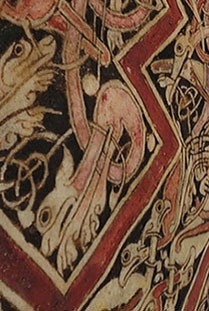
Digitalized images with historical overlays of two manuscripts – the illuminated St. Chad Gospels, dating from about 730 AD, and a Wycliffe New Testament from about 1410 — in the possession of Lichfield Cathedral.
Today’s Nifty Links
Link the first: A newly-released on-line archive of images from the French Revolution, done as a partnership between Stanford University and the Bibliothèque Nationale de France. There’s an article about the archive here; the bilingual, searchable archive itself is here.
Link the second: Over at John Scalzi’s blog, there’s an open comment thread going on, with writers sharing the most valuable bits of practical craft advice they’ve received or read.
Links to the Past
Writers of historical or alt-historical fiction are always in search of pictorial references for people and places of times past. Still pictures are good (and for most of history, they’re all that we have), but for over a century now we’ve had moving pictures, as well – and the internet, bless its digital heart, preserves them and displays them for us at our command.
Herewith, a trio of links:
London street scenes, 1927, in color: http://www.youtube.com/watch?v=Qgxki8_R968
Street scenes from Berlin and Munich, circa 1900-1914, also in color: http://www.youtube.com/watch?v=B-m9A8mY-U0
Driving around New York, 1928. This one’s in black and white, and is a staged comedy short, but the backgrounds are the real thing. (And it’s amazing how long some of the visual high-speed automotive tropes we’re still seeing in film and television have been kicking around.): http://www.youtube.com/watch?v=lkqz3lpUBp0
I love the internet.
 Dr. Doyle's Blog