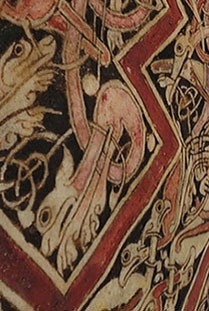
Digitalized images with historical overlays of two manuscripts – the illuminated St. Chad Gospels, dating from about 730 AD, and a Wycliffe New Testament from about 1410 — in the possession of Lichfield Cathedral.

Digitalized images with historical overlays of two manuscripts – the illuminated St. Chad Gospels, dating from about 730 AD, and a Wycliffe New Testament from about 1410 — in the possession of Lichfield Cathedral.
When it comes to typography, there are people who like to mess around with fonts (I plead guilty as charged) and then there are people who are obsessed with fonts . . . and those people can get just plain weird.
Consider the case of the Doves typeface, created in the late 1800’s for the Doves Press, a small press associated (like William Morris’s Kelmscott Press) with the Arts and Crafts Movement. The typeface’s creator, after a falling-out with his business partner, dumped all of the type — and the matrices for casting more — into the Thames River, in an effort to insure that no other press would ever use them. A century later, a digital font designer spent three years working from copies of existing books in the Doves typeface, re-creating the font in digital form.
It’s a fascinating story; you can read the whole thing here.
People at the University of Turin (and at the University of Pisa, and at the University of Mississippi, among other places) are digitizing the Vercelli Book, and the beta version is now on-line. The Vercelli Book is the Old English manuscript that contains, among other things, the poem known as “The Dream of the Rood” — “A Vision of the True Cross” would be a more accurate title, in my opinion, but custom is custom.
Seriously, folks, I would have given my eye-teeth for something like this back when I was studying Old English in graduate school. And the on-line grammars, and the on-line dictionaries . . . I counted myself fortunate, in those days, that I was able to convince my parents that copies of Bosworth-Toller (the big fat dictionary for Old English) and Cleasby-Vigfusson (the equivalent for Old Icelandic) made excellent Christmas and birthday presents. Given their size and weight, they also made excellent doorstops.
Why are Italian universities spearheading the Vercelli digitization project? Well . . . the Vercelli Book is called the Vercelli Book because it lives in the library of the cathedral in Vercelli, Italy. How a collection of Old English poetry ended up in Italy nobody is certain, but it’s been there since the 11th century at least. (Things became unsettled, to put it mildly, in England during the latter part of the 11th century; it’s possible the manuscript left home at that time. But nobody knows for sure.)
We’ve come a long way since the days when putting together a grammar or a dictionary or a variorum edition meant working with stacks and stacks of index cards. God, I love technology.
I could have saved this for posting a bit closer to the day, but by that time we’re going to have a house full of people and I’ll be lucky to get up a few sentences griping about punctuation trivia. That being the case, herewith a few of my favorite winter-holiday stories and characters from both written and visual media:
A couple of interesting links:
The British Museum (with help from Microsoft, who did the digitization) has released over a million images from books of the 17th, 18th, and 19th centuries onto the internet. A few of the highlights are here.
With the end of the year coming up, a lot of people are posting their best-reads of the year list. Science fiction author Fran Wilde has an interesting one, here. Full disclosure: my co-author and I have a story on the list.
It certainly looks like it. The Paris Review has interviewed Ursula K. LeGuin.
The interview is worth reading for a couple of different reasons . . . well, actually, at least three.
One is that the interviewer is not somebody from inside the science fiction/fantasy community, so the interview’s questions and answers aren’t the ones that a lifetime of reading interviews in Locus and similar in-group publications has trained us to expect.
Two is that the interviewer is not someone who knows a great deal about science fiction, to put it kindly, and watching LeGuin maneuver diplomatically around the resulting areas of ignorance is a pleasure to behold.
And three, this is Ursula K. LeGuin we’re talking about. She’s always interesting, no matter who’s interviewing her and for what.
It’s not that I have anything against large booksellers, or against chain booksellers . . . but I do believe that a rich and varied bookselling ecosystem is a good thing.
Right now, Star Cat Books is running an Indigogo fundraising campaign to help with the startup of a used-and-new bookstore in Bradford, Vermont, specializing in science fiction and children’s books. They’re looking to raise $8000 by the end of the campaign, and have just secured a matching donor for the next $2500 of the fundraiser, so for a limited time only any contributions made will go twice as far.
The book cover theory of genre fiction, as articulated by Debra Doyle, aka me:
Short (classic) form:
If it’s got a rocket ship on it, it’s science fiction
If it’s got a unicorn on it, it’s fantasy.
Once a book has a rocket ship on its cover, the only way to change it back into fantasy is by the addition of the Holy Grail
The inevitable smart-ass in the back of the room: But what if it’s the Holy Grail in the shape of a rocket ship?
Me: Then you’ve got the Hugo Award.
Special bonus side-cues:
If the cover features a person in heavy-duty powered space armor, it’s military sf.
If the cover features a person in a fancy uniform/dress coat with gold braid and similar decorations, it’s space opera.
And:
A zeppelin on the cover means alternate history.
A female person in corset and bustle, or a gentleman in a top hat, in the presence of either gears or zeppelins, means steampunk.
And finally:
Any otherwise mundane cover can be made into a fantasy cover by the addition of random sparkles.
I can’t decide whether this article in the New York Times is more insulting to Mormons (which I am not one of) or to writers of genre fiction (which I am):
Mormons Offer Cautionary Lesson on Sunny Outlook vs. Literary Greatness
But I do know that after a while, the unquestioned assumption that science fiction, fantasy, and young adult/children’s fiction are inherently lesser literary forms gets really, really old.
It has gotten better over the years, at least a little bit. With science fiction and fantasy having taken over so much of popular culture, at least it’s no longer the case that reading and writing the stuff is grounds for labeling someone a dangerous weirdo, or a pathetic basement-dweller, or a member of the tinfoil-hat brigade.
No, these days it merely labels us as not serious.
(It’s worse if you’re female. Being a girl means you start out with negative seriousness points.)
Granted, it’s good to be no longer reflexively sneered at by the likes of the New York Times. But being reflexively patronized isn’t all that much better.
Discovering traces of flawed humanity in an idol of one’s adolescence is a shocking thing; one almost never forgives the idol for being, after all, as imperfect as the rest of us.
This is, possibly, why YA authors in particular can draw such strong negative reactions if they stray in some fashion from the path of virtue: Their former fans can still remember that early rush of uncritical admiration, and — now that they’re all grown up and are trained readers and everything — it embarrasses them.
 Dr. Doyle's Blog