My Thoughts on the Hugos

Because I can’t hold up my head and call myself a science fiction fan if I don’t have some:

All in all, a victory for truth, justice, and the fannish way.

Also, the air that was full of smoke and dust and apprehension on Friday was clear and blue on Saturday, when the awards would be presented later that evening . . . which is a thematically appropriate weather progression that nobody could get away with in a piece of fiction, on the grounds of sheer implausible hokeyness.    But as is often pointed out, fiction needs to be believable, while real life is under no such constraint.

The Internet is Full of Nifty Stuff

On the days when it starts to feel like the internet is nothing but insult and outrage from wall to wall and floor to ceiling, it helps to go look at some of the other things.

For example:  here’s an informative post from Tumblr, giving workshop instructions on how, exactly to gird your loins (if you’re wearing long skirts, or a robe of some sort.)  Note that the process not only gets the material out of the way, but also provides certain crucial areas with extra padding.

This isn’t the same thing, by the way, as simply kilting up one’s skirt, which is a simpler process, involving tucking the extra fabric into one’s belt to shorten the garment.

And here’s a report on the recent RWA (Romance Writers of America) convention, including some very cogent remarks on the need for representation in romance.  Short version:  Romance is the genre of happy endings, and readers who aren’t cisgendered currently-able-bodied straight white women need books that say they’re just as entitled to happy endings as anybody else.

Finally, a couple of links that are pure catnip for a word nut like me: a compendium of the blogger’s own favorite posts from three years of All Things Linguistic, and a page from which you can buy a copy of Balþos Gadedeis Aþalhaidais in Sildaleikalanda – which is to say, Alice’s Adventures in Wonderland, newly translated into Gothic by the scholar David Alexander Carlton.

As Katta (the Cat) says to Aþalhaids (Alice), “Weis sijum her woda in allamma” – “We’re all mad here.”

Novella vs. Novelette

(Or, novelet.  The spelling varies.)

John Barnes explains the real difference, over here.   The explanation comes with a link to the first episode of an actual serialized novelet, also by John Barnes.  He’s a good writer and a clever guy – go read and enjoy.

Today’s Mail

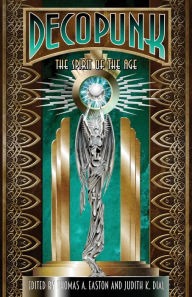
DecoPunk CoverIn addition to the usual unsolicited credit card  offers at rates that make “usurious” sound like a good deal, the postalperson today brought us our authors’ copies of the anthology Decopunk: The Spirit of the Age, which contains our short story, “Silver Passing in Sunlight.”

I really like that cover, by the way . . . if they made a poster out of it, I’d  put it on my wall.

Questions That Nobody Asked Me, Take One

Q.  I really loved To Kill a Mockingbird, and Atticus Finch was my hero.  Do I have to change all that in view of the publication of Go Set a Watchman?

A.  Only if you want to.

If you don’t want to, there are several good reasons why you shouldn’t have to.

Reason One:  Go Set a Watchman is not a sequel to To Kill a Mockingbird just because it takes place in a later decade.  It was written before To Kill a Mockingbird, but wasn’t published until just now.  If either version of Atticus Finch is to be regarded as the “real” one, the title should go to To Kill a Mockingbird Atticus (“Atticus Prime”, as the Star Trek fans would put it) rather than Go Set a Watchman Atticus (or “Reboot!Atticus”, to continue the Trek analogy), by right of prior publication.

Reason Two: Given that To Kill a Mockingbird and Go Set a Watchman, by virtue of their peculiar  history, do not actually stand in a text-and-sequel, or even a text-and-prequel, relationship, but are separate books, then Atticus Prime and Reboot!Atticus can safely be regarded as distinct and separate characters who just happen to share a name and place of residence.  (Again, science fiction readers already have a model to hand for dealing with things like this: two separate universes, parallel but different in some key respects.  Not quite Spock-with-a-Beard territory, but similar.)

Reason Three:  Go Set a Watchman, until recently, was never meant to be published at all.  It was what is sometimes referred to as a “trunk novel” — that is, an early work that the writer, usually for good and sufficient reasons, has put away in a trunk (or a desk drawer, or a computer file in an increasingly-obsolete format), never to see the light of day.

Sometimes, however, a trunk novel does eventually get published.  A writer may achieve sufficient popularity that it becomes a good bet that readers will buy even his or her old grocery lists, at which point somebody — maybe the author, but often the author’s literary heirs or executors — will decide to haul that manuscript out of obscurity and turn it loose on an unsuspecting public.

The reason for this, not surprisingly, is usually money.*  Either the author needs it, or the heirs-or-executors want it, or both. If the author is dead, and the heirs-or-executors are nowhere in evidence, then the coin involved is likely to be scholarly reputation.

So, no.  You don’t have to throw out your copy of To Kill a Mockingbird and consign Atticus Finch to the dustheap of abandoned role models unless you, personally, want to do that thing.  Which is your decision to make, not mine, and if I have any position at all on this, it’s that every person has a right to their own reaction to a work of art.

*Because writers have this annoying tendency to starve if they can’t buy groceries.  Go figure.
 

Two Peeves and a Link

Yes – it’s grey and rainy outside today, which means that it’s peeve time here in blogland.

Peeve the first:  It isn’t “per say” (though that’s what it sounds like.)  It’s per se, because it’s Latin, meaning “by itself.”  Per is one of those useful prepositions that also shows up as a prefix, usually one that means “thoroughly” or “extremely” or “completely” – probably from one of the other meanings of per-as-a-preposition, which is “through.”  (If you think that’s a wide range of meanings to stuff into a single word, just consider for a minute some of our English prepositions, which let us say things like “He came by himself to the house by the river by car.”  Which is an awkward sentence – I’d flag it in a heartbeat if I ran across it during a revision or editing pass – but not an ungrammatical one.)

But seriously, people, if you’re going to throw in Latin phrases, at least spell them right.

Peeve the second:  Don’t say “this begs the question” when what you mean is “this raises the question.”

Nobody, but nobody, gets this one right, and it drives me batty.  “Begging the question” is the English term for one of the common logical fallacies, also known by its Latin name, petitio principii, in which the person making the argument assumes as true, and argues from, the very thing which he or she is seeking to prove.  (For a fuller explanation, with diagrams, you can look here.)

Finally, to sweeten things a bit after that outburst of peevishness, a link:

The Science Fiction and Fantasy Writers of America 50th Anniversary Cookbook, edited by Cat Rambo and Fran Wilde, is now available for pre-order.  It contains 175 recipes as well as interior illustrations, and is available in both print and e-book formats.

Of Books and Stew

A brief thought on the science fiction and fantasy community’s ongoing Hugo controversy (which is too depressing to have more than a brief thought about, especially before noon; for more links than you can probably stand to shake a stick at, go here):

If books I especially like are considered as analogous to chunks of beef, while books I don’t care for that much are considered as analogous to a collection of assorted vegetables, then “this beef stew has more vegetables in it than I prefer” is a not unreasonable statement. Likewise, the assertion “this isn’t a beef stew with vegetables anymore, it’s a vegetable stew with beef” – while almost certain to be productive of considerable argument about the precise definitions of “stew” and “with” (and probably the definitions of “vegetables” and “beef” as well, once people really get going) – isn’t especially unreasonable, either.

What is unreasonable, though, is if I go on from there to shouting out loud in the public street that my local diner HAS BEEN TAKEN OVER BY A VEGETARIAN CONSPIRACY!!!

And if at any point I start threatening to burn down the whole diner if the proper proportion of beef (good) to vegetables (bad) is not restored, then I have become a danger to the community and ought to be gently removed from it.

Nifty Link of the Day

Sherwood Smith has a blog post up at the Book View Café, talking about women writing space opera (since there are still a few readers out there who, despite all the evidence, seem to believe that the possession of girlybits negates the ability to write about epic space battles.)

Full disclosure time here:  I would have liked this post even if it didn’t say good things about one of mine-and-my-husband/coauthor’s own space opera novels (and its sequels), The Price of the Stars.

Sampler Platter

Some time back, I posted a tasting flight of shorter works by important authors, in the interest of giving readers a way to decide whether or not they liked a particular author enough to go on and tackle one of that author’s signature doorstop volumes.  Now, as a follow-up to that round, here’s another quartet of shorter pieces by authors of important longer works.

Henry FieldingJoseph Andrews.  Tom Jones is the doorstop (and well worth reading for its own sake); Joseph Andrews is the short one, written in response to that other blockbuster of the eighteenth century, Samuel Richardson’s Pamela.  Richardson’s novel featured a virtuous maidservant who attracts the lustful attention of her employer, Squire B, possibly the world’s most incompetent rake.  He tries everything, including abduction and a fake marriage, but never works himself up to doing the actual deed; meanwhile, Pamela steadfastly holds out for honorable matrimony or nothing, and – spoiler alert! – gets her way in the end.  Fielding, for his part, found the entire plot so silly that he responded to it first by writing Shamela, an outright parody, and then by writing Joseph Andrews, which was what we’d probably call today the genderflipped version, with the title character being the handsome young footman who resists the advances of his employer, the licentious Lady Booby, widow of the late Squire Booby (hey, no one ever said that Fielding was subtle!), and is dismissed from his position and forced to go on the road as a result.

Charles DickensA Christmas Carol.  Charles Dickens was the Stephen King of his day (or maybe Stephen King is the Charles Dickens of ours): He wrote big fat novels, and he wrote a lot of them, for a long time.  A Christmas Carol is short, but it’s got enough of the Dickens flavor that you can figure out whether you want to go for one of the doorstops – Bleak House, say, or Oliver Twist.  (You can avoid Great Expectations, if you like, and I won’t blame you a bit.  It’s the one most often inflicted upon long-suffering high school students, and has probably turned a lot of them off of Dickens for life.  Lord knows, it nearly did it for me.)  Dickens also managed, with A Christmas Carol, to come up with one of the great recyclable plots.  Hollywood, in particular, has been running riffs and changes on it for decades.

Thomas PynchonThe Crying of Lot 49.  Pynchon’s another author best known for doorstop novels like V and Gravity’s RainbowThe Crying of Lot 49 – the title refers to an item being put up (or “cried”, as the terminology has it) for auction – is short and fast-moving, an ideal way to find out of you like Pynchon enough to try the big stuff.  Highlights include a centuries-old conspiracy of uncertain intent, a (fictional) Jacobean revenge tragedy, and one of the funniest games of strip poker ever written.

Alexander SolzhenitsynOne Day in the Life of Ivan Denisovich.  Russian novels are notoriously long as it is, and Solzhenitsyn carried on with the tradition.  One Day in the Life of Ivan Denisovich is an exception, being short enough to be published in 1962 as a complete-in-this-issue novel in the Soviet literary magazine Novy Mir.  If you don’t feel up to tackling Solzhenitsyn’s mega-doorstop nonfiction work The Gulag Archipelago, One Day in the Life will give you enough about life in a Stalinist-era Soviet prison camp to be getting on with.

Ursula K. Le Guin Gets Her Snark On

She read a New York Times interview with Kazuo Ishiguro about his forthcoming novel, The Buried Giant, which takes place in a non-historic just-post-Arthurian England, in which the author frets that his audience will say that it is fantasy.  (To be fair, it contains. among other things, a dragon.)    And she was moved to speak.

I’ve said this here before, and I’ll say it again:  One of the things I respect most greatly about Le Guin is her steadfast refusal to disavow the genre.  More than one author, upon attaining literary respectability, has stashed their propeller beanie and their Spock ears in the far back of the closet . . . all honor, then, to the ones who don’t.