The Fanfic Thing

The Guardian (or one of its on-line columnists, at any rate), has discovered the existence of fanfic, and the predictable kerfuffle has ensued.  This moves me to repost here some of my thoughts from the last time this argument came around, which it does every three or four years whether we need it or not.

So:

If you’re a writer, and you don’t like fanfic, either with regard to your own works or in general:

Don’t waste breath and ink and internet connectivity telling fanfic writers that what they do is morally wrong, because they aren’t going to agree with you.

Likewise, don’t bother telling them that it’s illegal, either, because some of them won’t care and others of them won’t agree with you, and these days — because fanfiction in its modern form has been around for several decades now — some of the people in the latter group are in fact lawyers, and will be happy to debate legal theory with you for as long as breath and ink and internet connectivity hold out.

Your best bet is to state plainly that the whole idea of fanfic about your universe and characters really and truly deeply squicks you out, and that you really wish that people wouldn’t do it. This will, oddly enough, stop a lot of people, and will convince at least some of the ones that it doesn’t stop to keep the stuff hidden away where you don’t have to see it. Which is, frankly, about as good an outcome as you can reasonably hope for.

If you’re a fanfic writer:

Don’t waste time you could be spending on writing and reading fic in arguing with vehemently anti-fanfic pro writers. It’s an emotional thing, and you won’t convince them any more than they’ll convince you.

If an otherwise sane and rational writer says he or she doesn’t want fanfic written about his or her work, at least consider not writing it. Or at the very least, don’t go out of your way to write it just because their arguments got your back up, because spite is a lousy reason for writing something. And if the muse is riding you hard and you just can’t stop yourself, at the very very least don’t wave the resulting fic around in places where the writer can’t help but take notice of it.

Also — it’s pretty much never a good idea to send a copy of your fanfic to the author in question. Even if they’re known to be kindly disposed toward the idea of fanfic in general, their reaction to fanfic about their stuff in particular is not to be relied upon — they may find it embarrassing, or may feel obliged to object to it for legal reasons regardless of their actual feelings, or may be concerned that reading someone else’s interpretations of the material will influence them unduly.

Common sense, people.  Exercise it.

On a Summer Day…

On a summer day just after finishing up a long-term project, it’s hard to think of anything substantive to say.

The final push to the deadline is an intense and exhausting thing, but one of the blessings it brings with it is a tightening of focus — stuff that isn’t The Book recedes from the forefront of your awareness so you can concentrate on the project at hand. Then you’re done, and as soon as the immediate post-finish adrenaline high subsides, everything else comes rushing back in.

I find that I’m usually in puppet-with-cut-strings mode for at least twenty-four hours after a deadline push.  At such times, I’m grateful for the slow cooker in the kitchen, which lets me put dinner together in the cool of the morning while I’m still as lively as I’m going to get under the circumstances.  Slow cookers make great writer tools.

Beadwork

Some writers can tell the story straight through in the right order, the first time out of the starting gate.  So far as I can tell, they see the end state of the plot waiting up ahead of them like the finish line, and once they start writing they drive on toward it.

I envy these people, because I am one of the other ones — the writers who see the story bit by bit, one component scene at a time, and not always in the right order.  For us, the finished novel often resembles not the record of a straight race to THE END, but a box full of brightly-colored beads that must be strung together in a way that makes sense.

Figuring out how to do the stringing, though, can be interesting.  Both Word and WordPerfect have Master Document functions that allow a series of files to be chained together into one long document, but when it comes to figuring out the actual order of those files, the user is on his or her own.  More than once in the past, I’ve had to resort to writing one-or-two sentence summaries of the files’ content on 3×5 cards, then physically laying out the cards in different orders and arrangements until I’ve found one that works.

Recently, though, I’ve taken to using Scrivener for my initial draft work, because its functionality emulates in electronic form what I used to do with those 3×5 cards.  It lets me work on individual scenes or chapters, and allows me to move them around and re-order them at will, and then will compile them into a single file for saving in a variety of formats.

(Then I take the large, compiled file over into WordPerfect for final editing and formatting, because they will take away my Reveal Codes window when they pry it from my cold dead fingers.)

Quick and Easy Deadline Dinners #1

Or, what Hamburger Helper wants to be when it grows up.

Pasta with Sweet Sausage and Cream

8 sweet Italian sausages, removed from their casings
1 medium onion, finely chopped
2 cups of heavy cream
2 tablespoons Cognac, optional
1 pound shell pasta

Place sausages and minced onion in a saucepan and cook over low heat until sausage is lightly browned. Break up the meat with a fork as it cooks, so it is crumbly. Add cream and cook until thickened. Heavy cream will never curdle, so it doesn’t matter if the cream comes to a low boil. It will thicken more quickly. Add cognac. Stir sauce gently through cooked pasta and serve.

This one is about as close to a no-brainer as a recipe can get.  When you’ve got a writing (or editing) job that absolutely has to get finished, plus a family that absolutely has to get fed — and deli-meat sandwiches or takeout Chinese for some reason aren’t in the cards — this dish will come through for you every time.

(Save it for emergencies, though, for your heart’s sake.  It’s not a dish you want to put on the table every day.)

Revision Research Weirdness

Today’s odd job:  Invoking the awesome power of the internet in order to determine whether or not the closed and abandoned 86th Street Station on the commuter train line in to Grand Central could be used to gain access to the street above.

Our editor had queried this, since the stairs leading up from the old platform are covered at street level by secure hatches.

We eventually found a photo reference showing one of the hatches standing open, with the panic bar on the underside clearly visible.  Victory!

(All this, in the service of about three paragraphs whose sole purpose is to get our protagonist from point A to point B without being spotted by the people who are watching for him at all the regular exits.  But here as elsewhere, God is in the details.)

Thought for the Day: Publishing Woes

Publishing isn’t dying, but it’s certainly going through some major traumatic changes resulting from cumulative changes in technology that are in the process of doing for ink-and-paper printing what movable type did for the scriptorium. Writers, as usual, stand to get all kinds of shafted, but there’s nothing new about that: any change in the status quo of the publishing industry is going to shaft the writers, because they’ve got their business survival methods all carefully worked out and tweaked to work with the way things got left by the last set of traumatic changes.

It’s no coincidence that one of the oldest poems in Old English, Deor, is essentially a poet complaining that the Hot New Guy has shown up and started scooping all the good patronage. The Wikipedia article on the poem says that “attempts at placing this poem within a genre are quite difficult,” but that’s probably because very few working scholars of Anglo-Saxon are also free-lance novelists.

Early Daze

I started wanting to be a writer not long after I started being a reader, at about the same time as I realized that books were things made by people, and not just the naturally occurring fruit of the fiction tree.

I wrote a lot of really awful stories and poetry in junior high and high school — the kind of thing that the term “juvenilia” was invented to cover, and thank God this was before the internet and the permanent archiving of everything, because if I’m lucky all of it got thrown out years ago — and finished my first book-shaped object during the summer between high school and college. It pretty much stank on ice, but I remember it fondly nonetheless, because I finished it and learned a lot about writing in the process. (Among other things, I learned that it’s a very bad idea to set an important action sequence in a cave, or in any other place without natural or artificial light. Your characters will spend far too much time fumbling with lanterns and lamps and candles, and you’ll have to keep track of who’s holding which and what gets dropped when and what happens when all the lights go out. I eventually gave up and — I told you the story stank on ice — resorted to lighting the whole scene with magically glowing rocks. I would have been better off revising the plot to get rid of the cave entirely, but I didn’t know that then.)

The short stories I wrote as a college undergrad weren’t much better; I was starting to get a handle on the concept of a prose style, but not so much of a handle on the concept of plot.  I made my first attempt at selling to The Magazine of Fantasy and Science Fiction during that time, and — not actually much to my surprise — failed to succeed.  I took another stab at writing a novel during my senior year, but the plot bogged down in Too Much Epic at about the same time as I got accepted into the graduate program at the University of Pennsylvania, and the book never got finished.  Bits and pieces of some of the themes and characters got recycled years later, though, so it wasn’t a total loss.

I only wrote one short story during the time I spent at UPenn — a Norse saga pastiche that damn-near wasn’t even in English — because Academia was taking up nearly all the available space in my brain.  The degree was totally worth it, though, not least because I learned that I could work for seven years on a project and carry it through to completion.  I also learned that the answer to “How long did it take you to write that book?” can be either “several years” or “a couple of months”, depending upon how you look at the process.

Two things started me writing seriously again:  the advent of affordable home computers (see “Down 48K Memory Lane“) and the sheer blinding boredom involved in being a Navy wife in an overseas billet in a country where reading material in English was not easily come by.  Those were the days before the commercial internet, when modems ran at 300 bits per second, 8-bit ASCII text files ruled the world, and new books arrived in town via slow boat from Hoboken.  If we wanted fresh fiction, we were going to have to roll our own, and so we did.  We eventually sold some of it, too, and that was the start of our freelance career.

(It was another two decades after that, however, before we finally sold a story to F&SF.  Persistence pays.)

Thinking About Criticism

Writers — as I should know, being one — have a tendency to regard literary critics as, at best, players for the other side.  They spend their time, the writer’s mind insists, in pointing out the flaws and failures of more creative minds; the novelist and poet Robert Graves summed up the writers’ argument most memorably in his poem “Ogres and Pygmies.”

It is, I suppose, an unavoidable problem with literary criticism: without meaning to, it gives pride of place to those texts which are productive of analysis. There’s a lot more that can be said about something complex, knotty, and variously flawed than can be said about something clear and simple and damn-near perfect. “Wow. You have got to read this!” is an honest response, and one most if not all writers would give their eye teeth to produce in their readers, but it never got anybody tenure.

But it helps, I think, to remind oneself that hidden inside every piece of literary criticism, no matter how labored or abstruse, is another voice saying, “This nifty bit of writing — let me show you it!”

Guest Post: Learning Curves

[Today’s post is a guest post, courtesy of Alice Loweecey, because I’m on the road this weekend.]

Learning Curves: They’re Not for the Timid

I’m a mystery writer. Well, not initially. From a wee age I wrote horror. Love the stuff. Started watching Hammer films with my dad when I was five. (Christopher Lee as Dracula can’t be beat.) Love dystopian post-nuke books too. So when I decided to pursue the dream, my first completed book was a post-apocalyptic horror.

That was a learning curve. I rewrote it four times.

Then I wrote a mystery. Which is nothing like writing horror. Learning curve #2. I discovered the joy that is outlining. I knew that I had to plant clues and remember where and when I planted them.

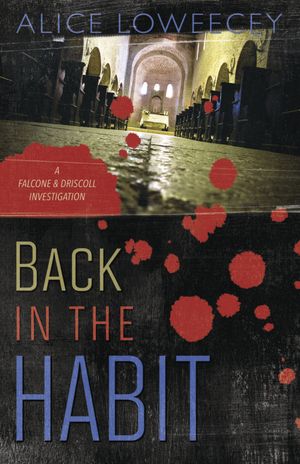
The good thing about the frequent and steep learning curves is that they taught me how to write tight, clean prose with 3-D characters. Those skills helped me get an agent and a three-book deal with the ex-nun Private Eye mystery. You can see their covers here: Force of Habit, Back in the Habit (both in stores now), and Veiled Threat (hits stores 2/8/13).

More characters moved into my head. YA characters.

I’m a mystery writer, I told them. They wouldn’t shut up. I’m a horror writer, I told them. Adult horror. Adult mystery. They ignored me and kept on yammering. I had to shut them up.

Learning curve #3: YA.

And I thought horror-to-mystery was steep and rocky. Hahahahaha!

I broke it down into manageable steps. First: Head to the library and read two dozen current YA books. Because these characters told me they lived in a post-cataclysmic dystopian Buffalo and Niagara Falls, I chose dystopian, paranormal, and UF books.

For one month, I read YA, taking notes on the differences between YA and adult. This placated the characters in my head.

The biggest differences were voice and speed. I’d forgotten that everything is life or death during the teenage years. How important what other people think about you is. How much you obsess over that and clothes and boys and parents and… everything.

The pace of YA is often much faster than adult fic. I saw less introspection and more action. Fewer gab sessions and more Run! Attack! Regroup! Sneak a kiss! moments. Not to say that the latter aren’t to be found in adult fic—not at all. But overall more things happen, and happen faster, in YA.

After I immersed myself in current YA, I returned to my never-fail creation tool: Character Charts. I use the ones from Randy Ingermanson’s Snowflake Method. I have the full version, which was part of my very first large writer’s conference. (Did I say learning curve? That was an eye-opening weekend.)

I start a new book with the MC, his/her love interest/partner, the antagonist, and a short pitch line. When I open the character chart and start with the basics—name, age, height, weight, description—the characters really begin talking to me. They look at the 30-plus items in the chart and tell me what they read and listen to, what they wear and where they work. What their dreams and fear are. This is how I learn about them and the plot—because what they tell me often shows me important plot points.

This was the familiar part of writing YA, because I do the exact same thing for an adult book. So was the next part—writing the outline.

Outlines aren’t for everyone. I pantsed my first book. But once I outlined a mystery, I was hooked. Some writers say that outlining the book from start to finish takes all the excitement out of it. For me, it’s like a basic knitting pattern. I know the measurements, but what I do with yarn and pattern stitches is new every time.

I kept the outline (an Excel spreadsheet) open in one window and the character charts open in another. New characters jumped into the outline as I wrote it, so I created a character chart for them. Items to research got their own column in the spreadsheet. Whenever I got stuck in the plot process, I switched to research.

Learning curve #4: What’s okay in adult fic isn’t necessarily okay in YA.

Yep, that means explicitness. When the book was ready to send to beta readers, they all advised me to tone it down. That meant the language and a few bits of nookie and innuendo that wouldn’t be a problem in an adult book. My agent had me tone it down even further—twice.

While I was still mulling this book over in my head, I talked to some writer friends who wrote extensively in YA. Their unanimous piece of advice was: Get deep into the MC’s head. Which led to…

Learning curve #5: First person.

All my other books (4 at the time of writing this YA) were in close third. I like close third. It’s my preferred reading and writing choice This YA started out in close third, and it was… wrong. The MC wasn’t alive. The story was flat. The dialogue was stilted. Everything stopped with a whump. I realized why a lot of YA was written in first. It lets the reader dive into the MC’s head and experience everything just as he or she is. I realized it worked especially well with YA’s faster pace.

So I looked first person in the eye and said: I will conquer you. I went back to the library and found half a dozen current YAs in first person. I put the WIP away and read all the books. Then I started over.

My MC opened her mouth and her story came alive. Her world, her family, her fears, her dreams. Four months later, I had a finished book. A month after that, I had beta comments and a revised draft to send to my agent.

That book is on sub to editors now—the final step to achieving the Holy Grail: A book deal

The learning curve—curves, plural—were worth it, no question. I’m a more skillful writer because of it. When (never ‘if’!) the YA sells, I have ideas for at least two sequels. Right now I’m writing a paranormal romance with a touch of steampunk. It’s not YA. But my next book could be. It all depends on who invades my head. And I’ll be able to write it because I didn’t back down from the learning curves.

Alice Loweecey is a former nun who went from the convent to playing prostitutes on stage to accepting her husband’s marriage proposal on the second date. Her teenage sons clamor for dramatic cameos in future books, but she’s thinking they’ll make good Redshirts. She is a member of Mystery Writers of America and Sisters in Crime. Visit her website at www.aliceloweecey.com and check out her books on her author pages at Amazon.com and at Barnes and Noble.
Take It Where You Can Find It

Good writing advice can be found in all sorts of places.

This page, for example, features a set of maxims for stage magicians.  Some of them are fairly magic-specific (“Look after your hands and nails. Make sure they are clean or painted”); others, though, hold true for anyone working in the arts and entertainment fields (“Making things as easy as possible for your audience comes before making things as easy as possible for yourself.”)

Though I suspect it never hurt a writer to have clean nails, either.